


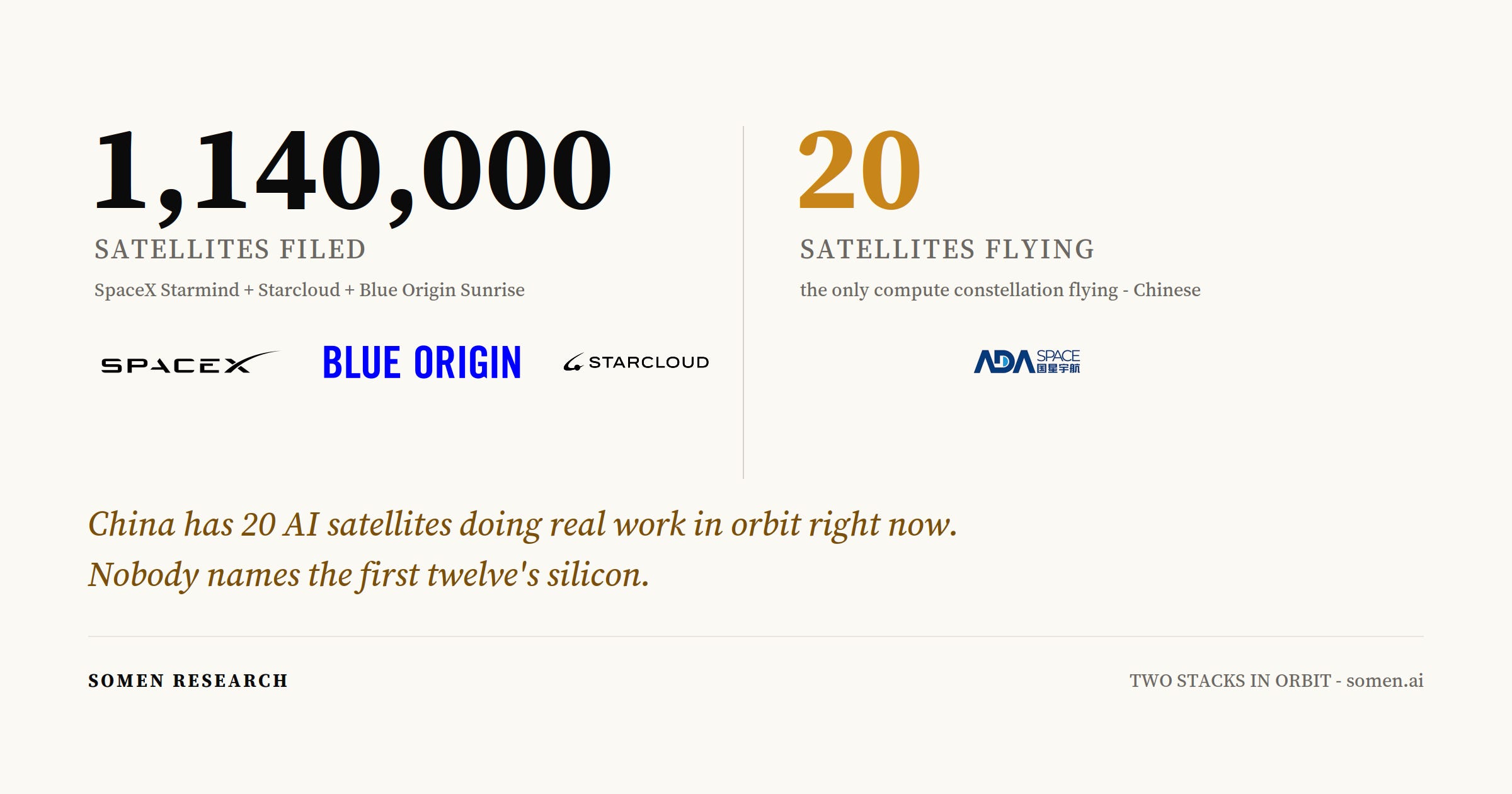
China has twenty AI satellites doing real work in orbit right now. The first twelve fly silicon no source we hold names; the eight that went up last week fly a chip almost no one has heard of.
The short version
The only multi-satellite compute network flying - satellites operating as a constellation, not hosted payloads - is Chinese: twenty satellites across two launches - the first twelve carrying 5 peta-operations of combined compute and 30 terabytes of storage, joined by eight more on October 14, ten AI models “deployed and tasked” in orbit, in the state-media phrasing, and Alibaba’s Qwen3 running real-world workloads since January.
The Western answer is filings: up to 1,000,000 satellites - verified at the FCC’s own acceptance notice, 88,000 - ICFS File No. SAT-LOA-20260202-00073, filed February 4, and 51,600 - with satellite designs the filings themselves describe as “currently being matured.”
The silicon inside the first-group fleet remains undisclosed at every primary we hold - but the second group, launched October 14, named its chip at launch: a startup’s part, XFEON’s StarCore S1, picked through ADA’s own multi-round testing. A domestic MetaX GPU flew in July on a Three-Body ecosystem satellite. What has not appeared in any public compute-constellation manifest we hold: an Ascend or Cambricon flagship part. A Chinese field survey still holds for the champions. NVIDIA announced a space-grade AI chip in March.
The money is different too: the two disclosed Chinese programs run on bank credit lines worth roughly RMB 15 billion, not venture rounds.
Both stacks drew circles around the same narrow, sunlit band of orbits. Both must clear a launch-cost gate no current rocket closes.
This is a structural read, not a prediction. The dated tests that could break it are at the end.
The inversion
Recently this desk published a map of the two AI compute stacks and found they converge at a single chokepoint: every advanced-node path runs through one maker of the finest chip-printing machines (extreme-ultraviolet lithography), which depends on two German suppliers. The map ends at the cloud layer. It should have kept going up.
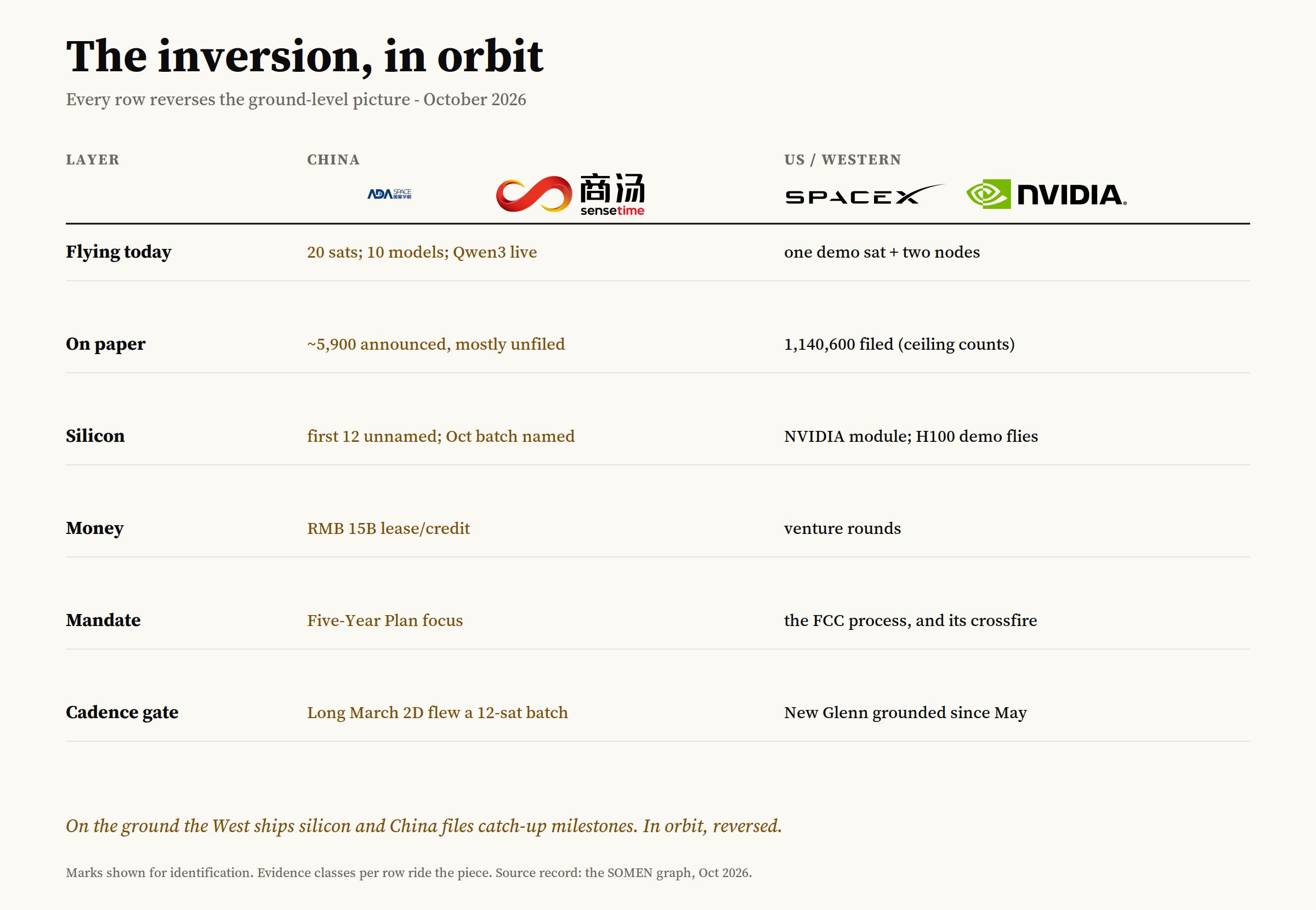
When it does, the stacks have swapped positions. On the ground, the American stack owns the silicon and the Chinese stack scrambles for it. In orbit, the Chinese stack owns the operating record and the American stack owns the filings.
Every row of that table is a reversal of the ground-level picture. On the ground the West ships silicon and China files reverse-engineering milestones. In orbit China ships constellations and the West files spectrum applications; the West’s flying hardware so far is a demonstration and two hosted nodes.
What is actually flying
Start with the fleet nobody covers. In May 2025, a Long March 2D lifted twelve computing satellites - ten of them built by ADA Space, a Chengdu company, stacked five to a cylinder on a payload adapter. State media put the fleet’s combined compute at 5 peta-operations per second - each peta a quadrillion calculations - with 30 terabytes of storage; the same report puts the finished constellation at 1,000 POPS. Nine months of in-orbit testing followed; by February, state media reported ten AI models deployed and tasked onboard, with laser links working between six satellites. On October 14 the fleet grew by two-thirds: a Zhuque-2E lifted eight more Star Compute satellites into dawn-dusk orbit - final-assembled on a Taizhou production line, LandSpace’s first compute-satellite mission, and carrying a named chip for the first time: XFEON’s StarCore S1 - and the payloads they will test read like a data-center spec sheet: 10-kilowatt-class liquid cooling, large deployable radiator structures, and the training of AI foundation models directly in orbit.
The workloads are not demos. A demonstration satellite trained a large language model in orbit in September 2024, fifteen months before the American claim to the same first. In November 2025, Qwen3 was uploaded to the constellation’s first-group compute center - the first general-purpose large model deployed from the ground to a running satellite, disclosed in January; end-to-end inference, question up and answer down, runs under two minutes. The constellation has been used to guide robots on Earth, offloading the compute to orbit and beaming instructions down.
The customers line up behind the fleet. In June, Tencent signed on for typhoon modeling over Shanghai. In July, SenseTime, one of China’s largest AI companies, contracted for dedicated computing satellites of its own - four flying before year-end, a thousand by 2030 - with compute the announcement describes, in the standard phrase of Chinese procurement, as “autonomous and controllable.” That phrase means domestic silicon. Which vendor’s silicon, the announcement does not say. Nothing does.
That is the finding. Not a chip we cannot identify - a chip the first fleet has never named, on the only multi-satellite compute network flying (satellites operating as a constellation, not hosted payloads).
A note on the sources behind that finding: the China-side record rests on state media and one specialist trade press service - china-in-space.com, an independent English-language newsletter on the Chinese space industry, formerly China Space Updates - with no independent benchmark or telemetry in the record we hold. That is not a caveat this desk can resolve from outside China; it is part of the read itself. The numbers above are what the record says, labeled by who vouched for them.
Behind the fleet, a whole field. Shanghai alone is running two programs. A Fudan-partnered “Star Pivot” project has already shown its first three-satellite verification unit - one compute node, one weather satellite, one remote-sensing satellite, laser-linked - on a phased path to a thousand.
Alongside it, a gigawatt-class “Pearl Constellation” would move part of the city’s computing off the grid entirely: verification of domestic compute payloads - and optical compute payloads - from 2027, with orbital inference sold by the token. Above the field sits the state. CNSA, China’s space agency, has opened a comprehensive feasibility study for a space-based intelligent computing constellation, the industry ministry is building a standards system for radiation-hardened chips and inter-satellite lasers, and the whole lane is a designated focus of China’s Five-Year Plan running through 2030. Many mid-scale constellations, one state umbrella.
What is actually filed
The Western side of the lane is a paperwork arms race. In late January, SpaceX filed the application its regulator’s acceptance notice describes as “a new non-geostationary orbit system of up to one million satellites” - a system it calls Starmind. An FCC “up to” is a ceiling, not a build plan - filings routinely request more than will ever launch, and this one is more than a hundred times the largest constellation anyone has flown. Read it as a reservation of orbital real estate under first-come rules, filed against rivals doing exactly the same. Starcloud - a venture-backed startup whose December orbit-trained LLM was widely billed as the first - followed on February 4 with 88,000 of its own.
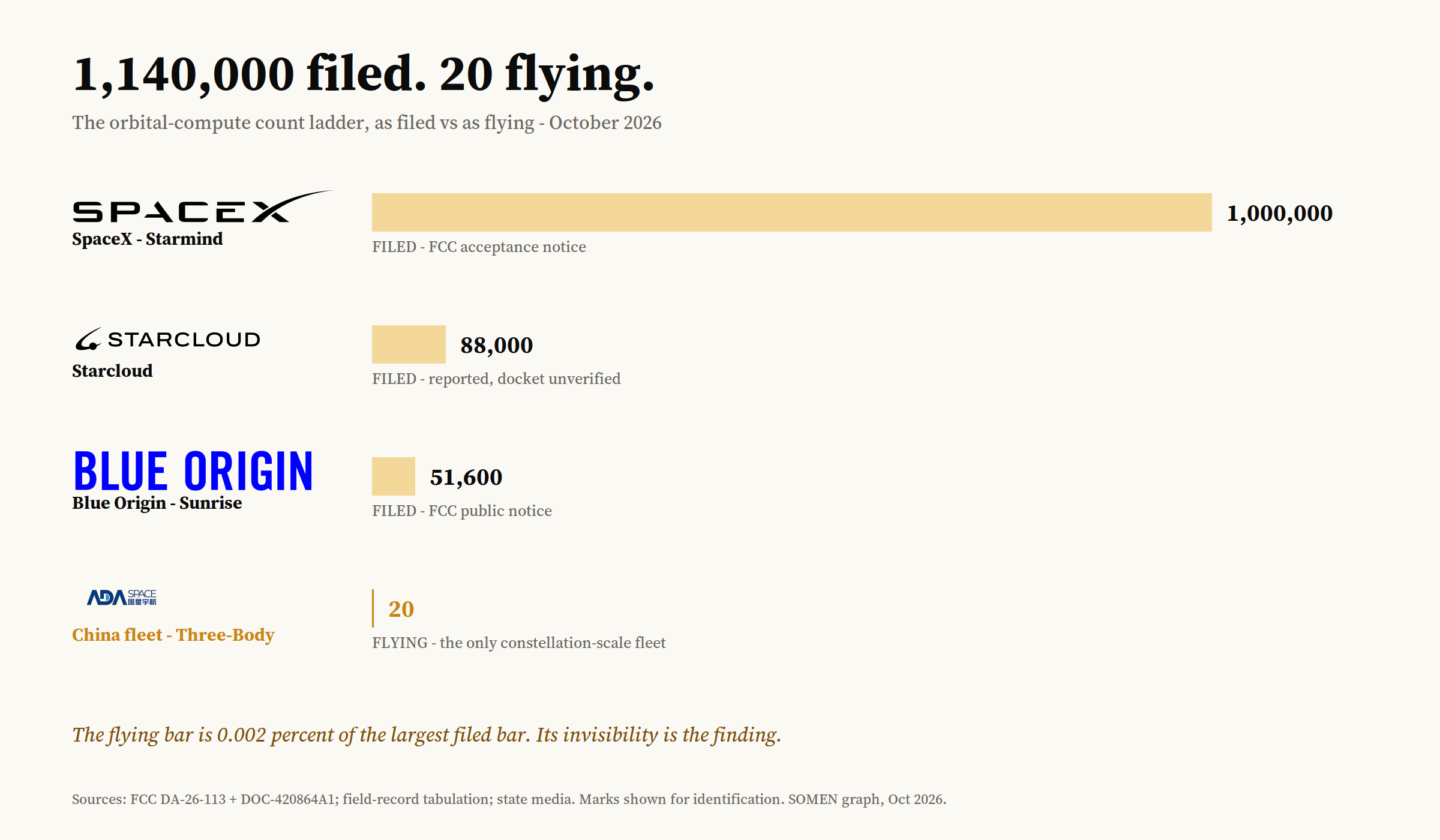
In March, Jeff Bezos’s Blue Origin filed for up to 51,600 - sun-synchronous orbits, the polar paths that keep a satellite in near-constant daylight, between 500 and 1,800 kilometers, laser links routed through its own planned 5,408-satellite TeraWave communications constellation. All three filings are now verified - two at the FCC’s own notices, the third in the official filing comments of the Secure World Foundation, which name ICFS File No. SAT-LOA-20260202-00073.
The filings describe ambition more precisely than engineering. Blue Origin’s application requests waivers from the buildout-milestone and surety-bond rules - the deadlines for deploying half a constellation, and the cash penalties for missing them - and concedes the satellite design is “currently being matured.”
The crossfire around them is a family argument. Amazon had petitioned to deny SpaceX’s application, calling it “a speculative placeholder rather than a complete application.” SpaceX then filed Amazon’s own petition into Blue Origin’s record, asking the Commission to apply the same arguments there - “to facilitate equitable and consistent review.” GeekWire’s summary: “Amazon opposed SpaceX’s filing, and then Blue Origin (both effectively controlled by Jeff Bezos) filed the exact same thing as SpaceX.”
The execution gaps are public. Blue Origin has launched zero TeraWave satellites; by April its New Glenn rocket had flown three times, and in May a fourth vehicle exploded on its pad during an engine test - the December return-to-flight target is a rebuilt launch pad’s schedule wearing a rocket’s name. One filing-week assessment noted the two-flight record; the count has since grown, the gap has not closed.
The regulator’s own reviewers flagged what the filings cannot: Blue Origin “has not previously operated a satellite constellation at any scale”, and its communications backbone is itself still a pending application. The FCC has accepted the filing; an amendment remains pending review. Acceptance is not approval, on either stack - and the Chinese projects largely have not filed internationally at all; the Space.IDC unveiling came with no regulatory paperwork submitted, which cuts both ways: no spectrum fight, and no accountability milestone either.
The silicon the champions won’t name
Here is the layer the filings skip and the state media will not name. What computes in orbit, today?
On the Chinese side, the honest answer is a method, not a part - and the absence at its center is an absence of disclosure, not a proven absence of hardware. A field survey of the Chinese space-computing industry - published on the unveiling of a national Space Computing Innovation Center in Beijing - maps seven suppliers. The “heart supplier” makes radiation-hardened spacecraft processors in the classic mold: SPARC V8-architecture chips and rad-hard reprogrammable logic chips, the computers that keep satellites alive, not the ones that train models.
The compute path that actually flies is different. One commercial operator, Galaxy Space, has run industrial-grade high-compute chips wrapped in space-hardening engineering since 2020 - commodity silicon, armored by engineering. The survey’s most candid sentence concerns the absent: Huawei’s Ascend and Cambricon’s processors are “extremely strong” on the ground, but no large-scale, self-developed, long-duration flight-validated radiation-hardened compute chip from either has publicly debuted. Absence of public debut is what the record we hold supports; proving absence would take launch manifests and export records this desk has not audited. And the edge of that absence dissolved this year, from the bottom: a MetaX GPU payload flew in July on a separate Three-Body ecosystem satellite - not one of the twenty - and passed its in-orbit reliability check, and the October batch named XFEON’s StarCore S1 at launch. Startups disclose; the champions’ flagship parts still have none flying in the compute constellations.
The one listed company selling star-borne AI units - Orbita, in Zhuhai - claims 70 TOPS (trillion operations per second) for its compute-in-memory module, a chip that calculates where it stores; the company’s own module datasheet lists 20 TOPS peak. A fork, not a spec - and in August the company named the chip: Yulong810A, self-developed and aerospace-grade, beside fully-domestic 12-TOPS and 60-TOPS boards. The claim and the product line still do not meet.
The Western answer arrived in March, at NVIDIA’s developer conference: the Vera Rubin Space Module, an AI chip line purpose-built for the space industry. NVIDIA now places compute in both stacks’ orbital plans - a merchant module for any buyer, and a full 72-chip Vera Rubin rack system as the declared payload of SpaceX’s first-generation satellite. The merchant-silicon layer that dominates the ground stack has announced its orbital extension before a Western compute constellation flies.
So the inversion, precisely - and it is organizational, not silicon: the stack whose silicon is its strength on the ground has no compute constellation flying, though the one Western compute satellite up there runs an H100 and its chipmaker has announced a space module; the stack whose silicon is its scramble on the ground has a constellation flying - and an opacity that is dissolving from the edge inward, startup by startup, champion flagship by none.
The money and the physics
The financing difference is structural. No Chinese orbital-compute company has raised a Western-style venture round. ADA Space carries a RMB 5 billion intended lease-financing facility from the Bank of China’s Sichuan branch and its leasing arm - satellite leasing, signed October 2025, plus backing from China Construction Bank and the sovereign fund CIC; the Space.IDC project signed RMB 10 billion in credit with two more banks.
The napkin: about $250,000 of intended bank lease financing per planned satellite. Inputs: ADA Space’s RMB 5 billion facility - an intended leasing amount, not drawn cash; its 2,800 planned satellites. A blended version - the lane’s RMB 15 billion of disclosed credit against the same 2,800-satellite plan - reaches about $750,000, but no document ties the whole figure to one fleet, so the desk carries the narrower number. Either way it is a floor, not a cost - and the only per-unit capital figure this lane has put on paper.
The physics both stacks share is harsher than the financing. The largest announced satellite on each side lands at the same order of magnitude: SpaceX’s first-generation satellite, AI1, at 250 kilowatts peak; the G3 flagship class at 140 kilowatts of solar generation for the Chinese Space.IDC project. The compute those numbers imply is a generation beyond anything flying.
The napkin: the flying fleet is on the order of a thousand times smaller than the paper fleet, per satellite - a cross-unit proxy, not a benchmark. Inputs: the state-media figure of 5 peta-operations across the twelve first-group satellites is roughly 0.4 peta-operations per satellite (the eight newest satellites’ compute is undisclosed, so the flying figure can only lean on the first batch); the announced G3 class claims 460 to 1,000 petaFLOPS per craft - a different unit count, operations against FLOPS, treated here as an order-of-magnitude proxy rather than a benchmark; the gap is three orders of magnitude either way. The Western paper fleet is 1.14 million satellites strong - and that count is regulator-forced disclosure, where the Chinese plan count is voluntary press; the comparison leans on an asymmetry the systems themselves create. The Western fleet flying is one demonstration satellite and two Axiom compute nodes riding a relay constellation since January; a Western compute constellation flying is still zero. Both stacks are asking for a generation of machine that does not exist; only one stack is flying the previous one.
And the gate neither manifest closes: Google’s own feasibility study priced orbital compute as cost-effective only if launch falls to about $200 per kilogram, a cadence requiring Starship-scale flight rates early in the next decade.
The same study’s radiation testing carries a quieter warning for both stacks: when Google put its AI chips in a proton beam, the memory - the high-bandwidth stacked DRAM beside every accelerator - was the most sensitive subsystem, though no hard failures appeared at mission-relevant doses. The most contested component on the ground may be the most fragile one in orbit.
The Chinese projects book small trucks - the Space. IDC first batch rides Orienspace’s Gravity-1 and Galactic Energy’s Ceres-2. The announced architectures converge on the same orbits, too: sun-synchronous, 500 to 1,800 kilometers, the one narrow band where the sun never sets. Both stacks filed the same ring of sky. It is a finite ring.
What would break this read
Dated, checkable, and none of them far away:
December 2026: New Glenn’s return to flight, carrying a Blue Ring spacecraft. A slip into 2027 pushes the Western launch-dependent timeline with it.
The Sunrise amendment ruling - pending review at the FCC now. Grant, denial, or return; the treatment of the requested buildout waivers is the tell.
Year-end 2026: SenseTime’s four satellites and Three-Body’s third group - the launches that would double the fleet again. The second group went up October 14, taking it from twelve to twenty; this clock has already started paying out.
An Ascend or Cambricon part in a compute constellation. The chip-opacity fork is already resolving from the edge - XFEON’s StarCore S1 flew on the October batch, a MetaX GPU in July - so the fact this lane now turns on is whether a champion’s flagship silicon flies. Cambricon’s own investor answer (February: the company does not work on LEO satellite edge computing) is one side of that fork.
2027: first Space.IDC G1 launch, Pearl Constellation in-orbit verification, Starmind’s first launches, a first flight for NVIDIA’s space module.
Where the two disagree, the arithmetic cannot lobby you.
References
FCC public notice, Project Sunrise application - docs.fcc.gov
FCC record, Sunrise amendment SAT-AMD-20260917-00370 - fcc.report
GeekWire, the Bezos crossfire and TeraWave count - geekwire.com
The Register, execution gap at filing - theregister.com
Secure World Foundation comments (Blue Origin) - swfound.org
Secure World Foundation comments (Starcloud, ICFS File No. SAT-LOA-20260202-00073) - swfound.org
SpaceBytes, LC-36 rebuild and December target - spacebytes.net
RedEye Eagle, FAA 12-to-50 launch-limit request - redeyeeagle.com
CCTV English, ADA Space Star Compute and the state layer - english.cctv.com
SCIO English (Xinhua wire), the first-batch founding figures - english.scio.gov.cn
Science Daily, Qwen3 orbital deployment and end-to-end latency - stdaily.com
Xinhua Finance, the ADA lease facility - cnfin.com
Orbita module datasheet - myorbita.net
china.org.cn, Three-Body in-orbit status - china.org.cn
china-in-space, the quiet-lead survey - china-in-space.com
china-in-space, the first-group launch quantified - china-in-space.com
china-in-space, the SenseTime deal - china-in-space.com
china-in-space, Space.IDC and the G1/G2/G3 classes - china-in-space.com
DBC field survey, the seven suppliers - enet16.com
Yicai, Pearl Constellation gigawatt class - yicaiglobal.com
TAIBO relays, Space String and Star Hub - en.taibo.cn, en.taibo.cn
Securities Daily, the WAIC field and phased plans - zqrb.cn
PCMag, NVIDIA Vera Rubin Space Modules - pcmag.com
Wikipedia, the space-based data-center field map (AI1 and Suncatcher figures as tabulated) - en.wikipedia.org
Eastmoney retail post, the Orbita TOPS fork - caifuhao.eastmoney.com
Counts derived from the live graph at edit time: 656 companies; 8 Chinese orbital-compute entities tracked; 20 satellites flying across two launches. Evidence classes ride each table row; retail-grade items carry their dispute inline.
- The SOMEN Desk