


The short version
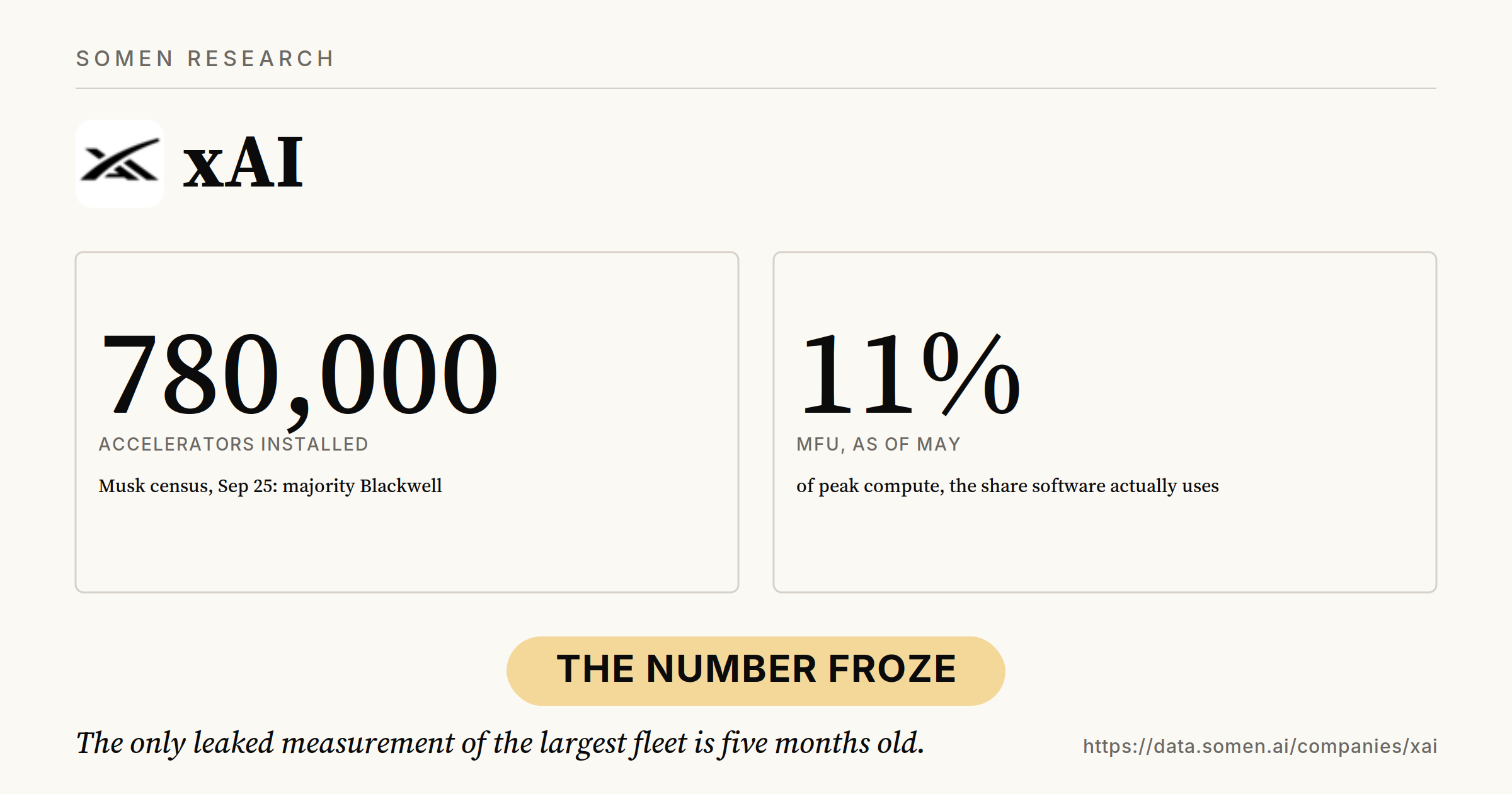
The installed base is Musk’s September 25 census: Colossus 1 at 150k H100 + 50k H200 + 30k GB200; Colossus 2 at 110k GB200 + 440k GB300 - about 780,000 accelerators, majority Blackwell. The year-end schedule takes Colossus 2 alone toward 1.21 million (the last of three 220k tranches is explicitly conditional); the fleet, if Colossus 1 stands, lands near 1.44 million.
The efficiency number is from May: training MFU near 11%, confirmed by an internal memo xAI’s president called “embarrassingly low.” It has not been refreshed since.
The comparison band - hyperscalers in the low-to-mid 40s - rides the same reporting wave, on smaller clusters, on possibly different arithmetic definitions. Treat it as an order, not a line on a chart.
If the comparison were like-for-like, the gap is roughly 4x training throughput on the same silicon. Two known reasons it may not be like-for-like, below.
And the leased object is not the May fleet: per the S-1, the lease covers capacity across both Colossus halls - terms the documents disagree about, a week apart (below). The hardware is not frozen at what produced the 11%.
The two states of the record
May. The Information reported, and an internal memo obtained by Business Insider confirmed, training MFU near 11% on a fleet then described as ~550k H100/H200 GPUs. One wire’s “60,000 GPUs actually used” gloss was wrong in the useful direction: MFU is not idleness.
MFU, in one line: of all the arithmetic a chip could theoretically do, MFU is the share your software actually wrings out. A cluster can be fully busy and still extract little.
The same wave carried the comparison set - Meta near 43%, Google near 46% - and the internal target of 50%. None of these are paired primary disclosures on matching hardware at matching scale, and MFU tends to fall as clusters grow; ByteDance has reported 55% on a 12k-GPU run, which is a different problem than a 500k one. There is also a definitional trap: against an FP8 peak the same workload prints roughly half the MFU it would against BF16. The May coverage did not say which denominator the 11% used.
October. The fleet is the census above - mostly GB200/GB300 now, with more landing in tranches through December. No public number updates the MFU on any of it. And the slack is monetized - on terms two documents, filed and posted a week apart, put in conflict. The filing side, per SpaceX’s own IPO paperwork: agreements for capacity across Colossus and Colossus II at $1.25B/month through May 2029, terminable by either party on 90 days’ notice. The other side, Musk’s clarification a week later: a 180-day lease, then mutual 90-day cancellation, short-term at SpaceX’s request - “has not committed to leasing Colossus for years.” (The ~325k-chip figure often attached is not the filing’s excerpt language, but neither is it mere relay: at least one outlet attributes it to what SpaceX said, outside the S-1.) Both statements belong in the record; the tension between them is itself the tenancy’s terms.
The book around it is a forward stack, not a billed one. Solid leg: Anthropic, S-1 language. Starting leg: Google’s $920M/month from this month. Conference leg: the ~$1.11B/month fourth tenant, billing from December 1 - a CFO remark, not a filing, and the same executive framed almost all the hosting deals as short, with a 90-day exit: stronger support than any number for reading this as an operating book, not a locked backlog. Soft leg: Reflection AI’s ~$150M/month, which lives in analyst posts and write-ups rather than the filing or the CFO record - count it and today’s billed book is ~$1.4B; without it, Anthropic stands alone at $1.25B. Run-rate if every leg lands: ~$3.4B/month. The filing’s own framing for the lease is the careful one: it monetizes unused capacity while keeping a reallocation right. (Coverage that says Colossus 1 was “inefficient for training, so rented out” is making a causal leap the record does not - the May MFU measured a Hopper training stack, not the Blackwell fleet, and is nobody’s stated reason for the lease.)
The napkin
IF May’s comparison were like-for-like: 11% against the low-40s is roughly a fourfold gap - an illustration of the order, not a measurement. The order is the finding; the multiple is arithmetic on two relayed numbers with no shared denominator.
Two reasons it may not be: the definition (BF16 vs FP8 peak - same work, half the printed MFU) and the scale (efficiency erodes as clusters grow; the comparison figures come from smaller ones).
The number that would settle it has not been printed since May. That is the finding.
Why it matters
The market translates fleet counts into capacity forecasts. If the largest fleets extract a fraction of their theoretical compute - and the only leaked measurement of the largest of them said 11% - then chip counts overstate effective training capacity by multiples, and part of the “compute shortage” is a software number wearing a hardware costume. The financing echo (this desk’s read, not The Information’s): clusters this size are borrowed against, and debt service does not care what fraction of the physics the stack extracts.
The refresh cadence is the tell to watch. xAI’s own target was 50% “in months.” If the next leak - on the Blackwell fleet, with a stated denominator - shows the ramp, the constraint story softens. If it stays quiet while the census grows, the silence is the datapoint.
The falsifier
A refreshed MFU disclosure above 25% on a like-for-like definition resolves the fork toward a software ramp; a number still near 11% on the 780k fleet confirms it. Tracked on the public scorecard, resolve by Jun 30, 2027.
Until it lands, the market is pricing a fleet it has never measured.
Sources
Seeking Alpha’s relay of Musk’s Sep 25 census, verbatim - Colossus 1/2 breakdown and the year-end schedule (Bloomberg also reported the post; this is the captured carrier)
The Information via our captured relay, with the BI-obtained memo - the May ~11% MFU, the “embarrassingly low” quote, the comparison figures, the Cursor rental. The primary objects are The Information’s report and the memo; this link is the relay we hold
Musk’s May 28 clarification - the walk-back: restates the filing’s dollars and dates, adds the short-term framing; carries no chip census
The hosting-book composite, via an aggregator - the four legs above; load-bearing claims graded leg-by-leg in the text
Numbers derived from the SOMEN graph at publication.
- The SOMEN Desk