

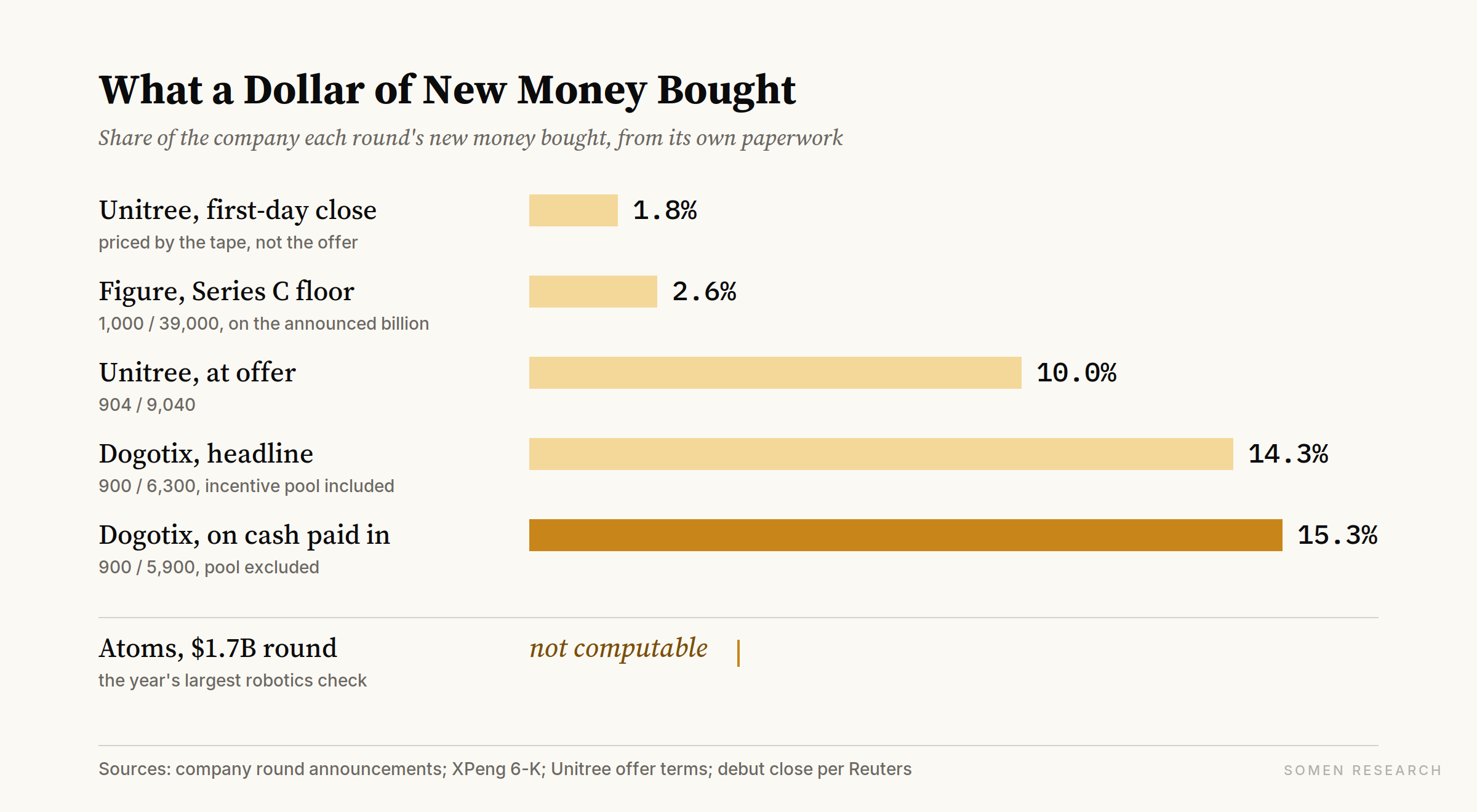
The desk keeps a napkin table. It prints one number per private company: the size of the last round divided by the post-money valuation that round itself set, meaning the price the whole company was marked at the moment the new money arrived. No projections, no comparables, no argument. Ten robot companies carry prices or price-claims in the graph. For the largest private robotics round of the year, the table prints nothing at all. Atoms raised $1.7 billion in July, led by a16z, and there is no valuation attached to it anywhere we can check. No round price, no tender (an organized buy of existing shares), no secondary print (private stock changing hands between strangers) on the tapes we read. The row exists. The arithmetic cannot compute it.
What makes that worth a piece is the company it keeps. In the weeks around it, the sector printed two other answers to the same question. XPeng’s robotics arm raised $900 million and told the market the number is $6.3 billion, while its own exchange filing, a Hong Kong announcement deposited with the SEC as a 6-K, shows a third of the money came from insiders. The company’s press release announced the round; the filing shows who actually wrote the checks. And Unitree, a Chinese humanoid maker, listed in Shanghai at a $9.04 billion valuation and closed its first trading day near $50 billion. The offer was priced in August; the debut repriced it within hours.
Three answers to one question: what is a robot company worth? Nothing, if you will not say. More, if your own shareholders help bid. Whatever the tape says, if you can find a tape. Each answer measures something different, and the differences are where an allocator gets hurt.
A quick orientation for readers who do not track the sector weekly. Figure and Skild are the American leaders, factory humanoids and a software brain that runs across many robot makers. Atoms is Travis Kalanick’s physical-AI holding company: kitchens through CloudKitchens, mining autonomy through Pronto, stated ambitions in transport. It is not a humanoid maker, its mark is not comparable, and it sits here because its round is the year’s largest.
Dogotix is XPeng’s carved-out robotics arm; Unitree and UBTech are the listed Chinese makers; AgiBot the largest private one; 1X is the OpenAI-backed consumer bet, Apptronik the Austin challenger backed by Google and Mercedes-Benz, Physical Intelligence the foundation-model shop. The table repeats the rest where it matters.
One table, ten marks
Every robotics mark in the graph, with the evidence class each number sits on. The grades are the desk’s; the links are the sources. Read them as ten measurement instruments that print in the same unit: the sector stops looking priced and starts looking surveyed.
The silence
Start with the absence, the largest number in the sector. Atoms merged its robotics businesses into one structure and raised $1.7 billion in equity from a16z, Bain, Uber and others in July. The round has no recorded post-money. The napkin rule is strict: a percentage prints only from a round’s own post-money. For atoms the field is blank, and blank is what the company chose.
The founder has been here before. CloudKitchens, Kalanick’s previous company, disclosed its valuation twice, both times within weeks of the money arriving: $5 billion in 2019, $15 billion in 2021. One compilation of the 2026 funding cycle catalogs the difference. The revenue figure is the founder’s own: a Bowl Builder kitchen robot, he said in mid-2024, “is already running a $2 million AUV restaurant in Pittsburgh, right now, delivery only.” AUV is one site’s annual sales, the number is his, and no customer or exchange has checked it.
Napkin. There is no napkin. No consolidated Atoms revenue is public, and the only figure anyone has is one kitchen’s $2 million. A kitchen is not a company. Force the fraction, 1,700 / 2 = 850, and you have measured a holding company’s raise against one site’s sales. The $1.7 billion has no usable sales multiple on any public number. The arithmetic cannot lobby you.
A statement about disclosed robotics sales, not economics: CloudKitchens is a large real-estate and operations business underneath this structure, and its numbers are not public either. The blank is a disclosure choice with three businesses behind it, not evidence of absence.
A single-source $9 billion figure did surface in late July. The aggregator RoboticsIntl attributed it to sources; the company PR and mainstream coverage carried no number, no other outlet has matched it, and no secondary market has printed one since. The round also came with debt from five banks, Bank of America, Goldman Sachs, Wells Fargo, JPMorgan and Barclays, in an undisclosed amount, so the total capital package exceeds $1.7 billion by an unknown sum. The desk carries it as a fork, not a fact: one outlet’s mark against the blank the company itself maintains.
Meanwhile the company behaves like a mark exists. Uber invested and is in talks over robotaxi plans, and a September hiring push into robotaxis was reported, people-sourced: no city, no permit, no fleet. A company raising at an undisclosed price while entering the sector’s most capital-intensive race is not hiding weakness from diligence; it is a company whose diligence is the founder’s to administer.
The internal mark
Dogotix, the XPeng robotics arm, published everything, which makes this the sector’s most inspectable round. The press release says more than $900 million at more than $6.3 billion post. The 6-K splits it: $600 million from institutions, $200 million from an XPeng subsidiary, $100 million from entities tied to XPeng’s own executives, including founder He Xiaopeng. One third is internal capital.
Napkin. The headline prints 900 / 6,300 = 14.3 percent. Strip the insiders and the external-discovery napkin prints 600 / 6,300 = 9.5 percent. On cash paid in the post is $5.9 billion, so the same $900 million buys 15.3 percent. Every fraction describes the same round.
China’s filings discipline is the point. A month after the West’s biggest round printed no price, China’s biggest printed the paperwork: a cap table (who owns what), a warrant schedule (the right to buy more shares later at a fixed price), a consolidation percentage, a closing condition, all on that Form 6-K. The filing’s own definition carries the softness: the $6.3 billion counts the new incentive pool at full size, shares reserved for employees that no one has paid for. On cash actually paid in, the post is nearer $5.9 billion; the last $0.4 billion of the headline is pool value. A mark you can audit downward is worth more than a mark you cannot audit at all.
The filing also carries the clock: 1,000 IRON humanoid units per month by December 31, 2026, with first next-generation units already off the Guangzhou line. Miss it badly and the $6.3B conversation, and the spin-off XPeng retains 82 percent of, gets repriced before the carve-out completes.
The public tape
Unitree joined UBTech on the public tape in August, and its first day did more to move the sector’s numbers than any round this year. The IPO priced 40.45 million new shares at RMB 150.80, a $9.04 billion post-money. On debut the stock opened up 629 percent and closed up 460 percent, a first-day value near $50 billion against 2025 revenue of RMB 1.7 billion.
Napkin. At the offer, the raise bought 10.0 percent of the company (904 / 9,040). Priced at the first close, the same money bought about 1.8 percent. The public market repriced the napkin five-fold in seven hours of trading.
The tape also grades the demand. The listing inquiry, the written question-and-answer a company trades with the exchange before listing on Shanghai’s STAR board, forced Unitree to break out its humanoid revenue by domain. For the first nine months of 2025, the filing’s answer is 73.6 percent research and education, 17.4 percent commercial and consumer, and 9.0 percent industry, as tabulated by the research letter Core Matter.
The 9.0 percent is filed, and per the inquiry response as reported in Chinese financial press it splits once more: explicit industrial applications, manufacturing and inspection, produced RMB 15.7 million of humanoid revenue in the same nine months, about 2.6 percent. On the letter’s read, most of the remaining bucket is showroom tours; an investor’s interview-based account lands in the same place. The world’s most-watched robot price is set by labs and universities, not factories.
UBTech, the other public print, is the receipt for actual sales. Audited FY2025: RMB 2.0 billion of revenue, of which RMB 820.6 million from 1,079 full-size humanoids sold into factories. The net loss narrowed to RMB 789.8 million. H1-2026 delivered RMB 590.3 million of humanoid revenue, 921 units, already most of the way to the prior full year. That is what an exchange-checked robot company looks like: real, growing, loss-making.
One more filed number, because the piece leans bearish: Unitree, the same tabulation shows, is the one humanoid maker in the set that printed a profit, RMB 288 million of reported net income for 2025. Its prospectus reconciles the figure: RMB 278 million attributable to shareholders, RMB 591 million with the one-off share-based charge added back. The sector’s most expensive humanoid is its only profitable one, on research-led volume. That is what the first-day tape, 210 times 2025 sales, is defending.
The asks
Between the silence and the tape sit the private asks. A year ago the sector priced against its own press releases; this year the asks quote against the one exchange print that exists.
AgiBot, the Shanghai humanoid maker, confirmed to Caixin in July that its Hong Kong IPO process has begun, with CICC, CITIC and Morgan Stanley reported as sponsors, and a target of HK$40 to 50 billion (roughly $5 to 6.5 billion), per one investor’s account to Caijing, from cornerstone investors, the anchors who commit money up front so a listing can go ahead.
Its private mark, above RMB 20 billion, is press-grade. Run the HK$40 to 50 billion ask against the RMB 1.05 billion of 2025 revenue the company itself disclosed and it prints roughly 35 to 45 times; Unitree, the one exchange-priced offer, printed about 38 times. AgiBot is asking private money to pay an offer-day multiple on a denominator no exchange has checked. A structural comparison, not a quality-of-earnings one: Unitree’s denominator survived a STAR inquiry; AgiBot’s is company-disclosed.
Figure holds the sector’s largest private mark, $39 billion, set by its own September 2025 announcement of a round led at over $1 billion. It has never published an ARR (annual recurring revenue) figure, so the mark has no denominator.
What it has is the sector’s best operating record, which needs reading more carefully than the aggregators allow. Figure’s own account of the BMW work describes an eleven-month pilot on one task, sheet-metal loading in the body shop: 90,000-plus parts loaded, 1,250-plus runtime hours, contributing to 30,000-plus X3 vehicles, then retirement of Figure 02 in November. Contribution on one insert task is a real pilot, not a factory run-rate.
What happened next is the part the aggregators flatten. BMW announced in June that Figure 03 returns to Spartanburg, out of the body shop and into a harder task class, sequencing parts in the logistics halls; Figure’s companion post puts the robot in Hall 52. A second customer, Catalyst Brands, signed in May for its distribution network. The canonical deployment is a bounded pilot with a real output number, a re-up on a harder task, and a second site. That is what progress looks like, and it is slower than every mark in the first table.
Apptronik shows what the extension round, a top-up that stretches an old round instead of setting a new price, has become. The company announced $520 million in February, closing its Series A above $935 million, at three times the original Series A’s valuation twelve months earlier. It announced the round and not the price; CNBC put it near $5 billion, TechCrunch at $5.3 billion, Bloomberg above $5.5 billion, so the desk carries no valuation.
And 1X is what happens when the ask meets the shipping schedule. The consumer humanoid maker sought up to $1 billion at $10 billion or more in September 2025 and, per The Information, raised less than half. NEO preorders sold out a 10,000-unit first year in five days at $20,000 or $499 a month, and SoftBank is now in talks for a majority stake at roughly $6 billion.
A control position normally prices above a minority mark. Here it prints 40 percent below the ask. Demand the order book could measure met a delivery schedule it could not: no customer NEO delivery has been publicly confirmed.
Where the demand comes from
Every demand number in this piece has an origin, and the origin is often the seller’s own circle. Pricing that origin is the allocator’s job.
Start with the clearest case. EQT, which led 1X’s Series B, is reported by one compilation to be the counterparty of a framework deploying up to 10,000 NEO units across its own portfolio between 2026 and 2030; neither party has confirmed it. An investor underwriting demand from its own portfolio is a channel, not a market.
The strongest tape has the same shape at scale. Unitree’s filed demand is three quarters research and education, and per the same inquiry-document tabulation, the research segment runs substantially on state university and institute budgets, backed by a June directive from China’s industry ministry and state-asset regulator targeting roughly 10,000 humanoids in commercial use by end-2026. The world’s most-watched robot mark may be reading policy flow as much as customer pull; the filed numbers cannot separate the two.
The private side is smaller but no cleaner. Skild’s founders publish 60-plus paying customers, mobility work at 10 percent of revenue, Fetch-derived solutions at 4 percent. Figure’s second signed site is a brand-apparel distribution network. The question is not who buys; it is why the buyer’s own incentives point at the robot.
None of this is illegitimate; it is demand an allocator should price differently, and the sector’s revenue figures rarely separate the two. The circularity reading is a hypothesis; no filing yet separates sponsored demand from walked-in demand.
What the marks would have to explain
Each company’s deployed, checkable output, in its own units. Tons, units, vehicles and preorders are not comparable; the checkability is. The grade column is who vouched: filed means an exchange checked it, customer means the buyer announced it, company means the seller announced it, prospectus means the company’s own IPO paperwork.
Look at the top row. The hardest operating number in the sector, two million tons of limestone moved by driverless trucks on a working quarry, belongs to the company with no valuation at all. The customer announced it, not the vendor. The desk does not know what the silence is protecting. One reading says a number would look small against the tonnage. Another says it protects room to maneuver toward robotaxis, and the Uber relationship is consistent without proving it: an investment, hiring chatter, no city, no permit, no fleet. A third says nothing is protected at all: this founder has printed marks when it suited him and gone quiet when it did not. None of the three flatters the $1.7 billion’s missing denominator, and the blank cannot make Figure’s $39 billion look cheap or dear: an absence prices nothing.
The multiples
Assemble the only computable ratios and the grammar of the sector writes itself.
Skild is the one private company with both sides of the fraction. $14 billion set by its own Series C announcement,against a $100 million run-rate (annualized current sales) its founders published, is about 140 times. The same founders put 2025 actual revenue near $30 million in that January announcement, so the two figures are one trajectory, not two desks disagreeing; the climb from 30 to 100 in eight months is company arithmetic, unaudited at both ends. The denominator is ten months past first commercial deployment; treat it accordingly.
Unitree is the only multiple an exchange has priced. At $9.04 billion post against 2025 revenue of RMB 1.7 billion, roughly $237 million at 7.2 to the dollar, the offer printed about 38 times. The first day’s close, near $50 billion, is roughly 210 times, to be graded by a lockup clock (the months after listing when insiders may not sell) rather than by a customer.
Read the sequence in order of verification: 38 exchange-priced, 210 chosen by the first day’s tape, 35 to 45 asked on unaudited disclosure, 140 self-published, then the top of the private market, where the fraction cannot be formed at all. In this sector, the multiple is not a measure of the business. It is a measure of how far away the audit is.
The floor is visible too, and it is the bear case. The one audited profit-and-loss in the sector still shows RMB 790 million of annual loss on RMB 2.0 billion of revenue, and the inquiry’s domain breakdown agrees. Nothing in any audited filing yet shows the industrial demand the private marks are priced on. The sector may grow into its numbers; nothing filed so far proves it has.
Figure’s own napkin makes the same point from the other end. Its September 2025 round raised over $1 billion at the $39 billion post, printing 2.6 percent, a floor: the committed figure was higher, so the buyers’ stake is at least that. New money at Dogotix bought 14.3 percent of the headline, 15.3 on cash paid in; at Unitree’s offer, 10.0 percent; at atoms, nothing computable at all. Same sector, same season, four different prices for a percentage point of a robot company.
The compute crossover
The last thing the marks have to explain is what the money is for. The sector’s private leaders are no longer building robots; they are buying compute, on the AI lab playbook. Figure committed an initial $3.5 billion and stated intent beyond $6 billion for access to up to 100,000 NVIDIA-class GPUs through Nscale, with the supplier taking an equity stake in the same announcement. Skild’s foundation model (one trained brain for many robot types) runs on NVIDIA’s Physical AI stack, its chip-and-software bundle for robots, NVIDIA an investor from its $1.4 billion round. A $39 billion mark with no published revenue committing billions to GPU access is not a robot company’s balance sheet. It is an AI lab’s, with hands.
That does not make the marks wrong; it makes them compute-counterparty bets, claims on foundation models for physical manipulation and on the deployment layer those models need. The desk traced this pattern one layer up, in the clouds and labs; it is now robotics’ cost structure too.
At the model layer, Skild’s S1, announced in August, is pitched on learning a physical task from a single demonstration,and the company says real-world deployments arrive by 2027. Until then, the $14 billion is priced on the same grammar as every other mark in this piece: somebody’s say-so, graded only by the calendar.
Evidence, falsifiers, and the clock
Strongest first, by evidence class: filed numbers (UBTech’s HKEX reports, Unitree’s offer terms, inquiry-domain breakdown and its press-relayed industrial sub-split), customer-announced operations (Heidelberg’s tonnage), company announcements (every private round price and run-rate), press and people-sourced (AgiBot’s target, SoftBank’s talks, Tesla’s supplier reporting), and one single-aggregator figure (RoboticsIntl’s atoms mark), a fork, not a fact.
This piece is a watchlist, not a trade. Each claim above has a date that will grade it:
Atoms: any number surfacing by any route: a tender, a secondary, a next round, a robotaxi permit with a city attached. The silence is the position; it resolves the moment it breaks.
Dogotix: the completion 6-K and the 1,000 IRON units per month deadline of December 31, 2026.
Unitree: the lockup and the first secondary print, grading the $50 billion debut against the $9 billion offer.
AgiBot: the HKEX prospectus, whose price range either underwrites the 35-to-45-times ask or joins the targets cornerstones declined.
Skild: the EU Machinery Regulation applies from January 20, 2027, and the company has not said whether it sells into Europe.
1X: SoftBank’s deal closing or dying, and the first NEO delivery a customer can confirm.
Physical Intelligence: the reported $11 billion round confirming or collapsing; deal databases carry it completed May 21 at about $11.2B, EDGAR full-text shows no Form D, and no major has confirmed a close as of September 28.
Tesla: the Q4 2026 call, where production numbers are due instead of timelines.
The desk’s public scorecard carries this falsifier set; each resolution gets graded on the record when it lands.
One last note on method. Every link resolves to a source the desk has stored and dated in its graph. Arithmetic is labeled as a napkin; desk conversions use 7.2 RMB to the dollar, debut values are closing prints, and cited dollar figures keep their sources’ conversions. Post-money means what the filing says: Dogotix’s $6.3 billion counts the incentive pool, its $5.9 billion does not. Round money is not one claim: Figure’s $1 billion is committed, Dogotix’s $900 million conditional, Atoms’ $1.7 billion equity plus unnamed debt. The grades in the tables are ours. The numbers are the companies’.
- The SOMEN Desk