


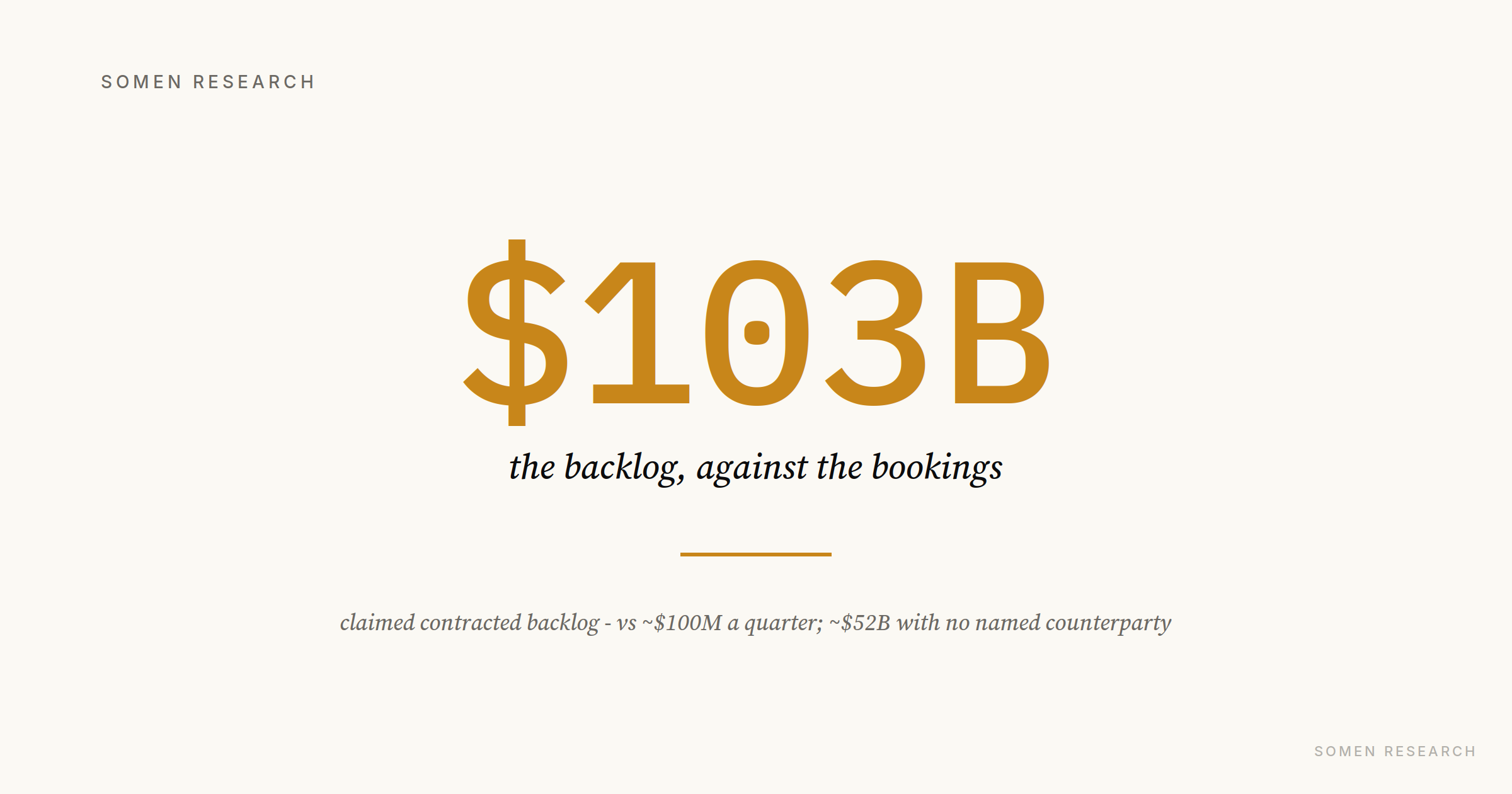
Nscale tells prospective IPO investors it has roughly $103 billion in total contracted revenue. The same roadshow documents put recent quarterly bookings near $100 million. That is a claimed backlog roughly one thousand times the bookings in the most recent quarter, and the backlog figure doubled from about $51 billion to $103 billion in twelve days, per documents reviewed by The Information; Reuters reported the figures, carried by Channel News Asia. A source in those documents cautions that the figures are illustrative, not formal guidance. The company is not saying it recognized the revenue; it is saying it has contracts. The audited revenue lines in the public record sum to roughly $21 million, all Norwegian, all FY2024; none can test the claim.
The company says a $14.6 billion valuation from its Series C is supported by these contracts. The secondary market has priced a share at $786.84. No share count is filed. The count the two numbers imply, roughly 18.6 million (and assuming the $433 million SAFE has converted), makes them arithmetically consistent; whether round and trade describe the same share class is not answerable from any filing either. One number is a round; the other is a trade. They can both be true, or the share count can be wrong, or the Hiive print can be stale, or the share class can differ. What they cannot be is independently reconciled without a filed cap table.
What would resolve the gap is simple: filed FY2025 accounts, due 30 September 2026 and not filed as of 4 September; a formal S-1; or an auditor’s note on contract assets. Until then, the $103 billion exists only in non-public roadshow documents. That is the burden of proof. You are being asked to underwrite a primary allocation on counterparty paper no public filing evidences. The IPO could price within weeks, with Goldman Sachs and JPMorgan reportedly engaged and the raise possibly up to $3 billion. The calendar is the test.
A company with an $18 billion annualized contracted run-rate, implied by $103 billion over 5.7-year average contracts, and a $100 million quarterly booking pace is either about to print the steepest revenue ramp in the sector or the backlog is not what the word contracted usually means. No party has said whether the commitments are take-or-pay or usage-based, and no filing carries termination or step-in rights: if they are usage-based, the $103 billion is optionality; if take-or-pay, roughly $18 billion a year is a floor against a revenue line no filing yet shows. The source’s own language is the tell: illustrative, not formal guidance. That is not a disclaimer the company can disown later if the IPO prices on a contracted-revenue narrative. It is the exact language an allocation committee must weigh.
The record does contain one independent confirmation that realized results are not yet material. Aker ASA, the largest shareholder, carried its stake at NOK 32,066 million fair value and wrote in its half-year note that all material projects remain in the development phase, so the investee’s result is expected to be limited primarily to administrative expenses. That is not a revenue statement; it is the absence of one, filed by the party with the most to gain. Aker’s own 22.7 percent fully diluted stake and 26.4 percent of gross asset value exposure means the shareholder has every incentive to describe this as a ramp. The equity-method line declined to, even as the same note catalogs the buildout’s contracts. The carrying value also implies an independent mark: NOK 32,066 million at 22.7 percent fully diluted is roughly NOK 141 billion of equity value, about $13.5 billion at recent rates, against the $14.6 billion the round claims.
The Anthropic and Figure agreements supply the backlog narrative. Anthropic is reported to have agreed to roughly $45 billion to rent about 460 MW at the West Virginia campus, with operations expected by the end of 2027. Figure’s agreement covers up to 100,000 NVIDIA Vera Rubin GPUs, a $3.5 billion initial compute commitment intended to scale above $6 billion, with initial deployments in the second half of 2027 in Barstow, in Ward County, Texas, where the $1.85 billion term loan sits; the debt plausibly funds this buildout. Nscale is also making an undisclosed strategic investment in Figure, and NVIDIA is an investor in both companies, so the supplier is partly funding its own customer. The named deals sum to roughly $48.5 billion, about $51 billion at Figure’s full intended scale, which is almost exactly the backlog figure Nscale gave investors in August. The incremental $52 billion of the September claim has no named counterparty. Those are large names and large numbers. They are also future-dated and not observable in a current income statement. A contract to deploy capacity by the end of 2027 is a promise, not a receipt.
The short version
$103 billion claimed, about $100 million booked a quarter. A roughly 1000x contracted-to-booked fork; the backlog doubled from $51 billion in twelve days; a source in the roadshow documents calls the figures “illustrative.”
The named deals sum to the old backlog. Anthropic ($45B) plus Figure ($3.5B initial, about $6B intended) almost exactly reconstructs August’s $51 billion figure; the incremental $52 billion of the September claim has no named counterparty.
The largest shareholder implies a lower mark. Aker’s half-year note expects realized results to stay near administrative expenses through the development phase and carries the stake at a level implying roughly $13.5 billion of equity against the round’s $14.6 billion (conversions at about NOK 10.5 to the dollar).
13.7 percent. The Series C put $2 billion into Nscale at a $14.6 billion post. The arithmetic cannot lobby you.
254 open roles, 21 GitHub stars. A global infrastructure hiring ramp behind a thin public code surface: the buildout is being staffed, not yet evidenced in bookings.
Every filed revenue line in the group that can be read is Norwegian and KPMG-signed: about $21 million, FY2024. The asset company holds the infrastructure and carries negative equity; the terms of service still contract through a 2018-vintage entity. Which entity owes Anthropic is unstated.
The falsifiers are dated. FY2025 accounts are due 30 September 2026 and will test the baseline (the filed revenue trail), though the period predates the Anthropic and Figure signings; the S-1’s backlog note, its structure disclosure mapping which entity owes whom, and the auditor’s contract-asset note are the tests that can actually grade the claim.
Valuation and revenue analysis
The $786.84 Hiive print is a market reference, not a clearing price; it is a secondary indication captured 2 September 2026, and the capture five days earlier read $832.99: a moving tape on thin volume, which is its own caveat. It implies the Series C $14.6 billion post-money only under a count of roughly 18.6 million shares, which no filing confirms; if the print and the round describe different share classes, no comparison is possible.
The valuation arrived after a compressed funding stack. The public record lists a $30 million seed in December 2023, a $155 million Series A in December 2024 led by Sandton Capital Partners, a $1.1 billion Series B in September 2025 led by Aker ASA, a $433 million pre-Series C SAFE in October 2025, and a $2 billion Series C in March 2026 led by Aker ASA and 8090 Industries. That is $3.718 billion in equity and SAFE commitments in roughly 27 months. The Series C set the $14.6 billion post-money. The pace of capital formation is unusual, even for data-center development.
Debt followed the equity, and the details sit in the funding section below. The debt is available, not necessarily outstanding, and the balance sheet cannot yet settle the difference.
Revenue evidence, by contrast, is thin. The UK holding company’s FY2024 accounts, Nscale Global Holdings (company 15749408), run from 29 May to 31 December 2024 and were filed as scanned images; the figures are not machine-extractable. FY2025 accounts are due 30 September 2026 and were not filed as of 4 September. That means the $103 billion contracted backlog and the $100 million quarterly bookings cannot be tested against a balance sheet or income statement until the due date passes or a filing lands. The company’s own press page carries announcements of financing and partnerships, not a revenue release.
The booking pace is the cold number. The documents reviewed by The Information put contracts at a 5.7-year average, implying an $18 billion annualized contracted run-rate. The same roadshow reports put the quarterly figure near $100 million, whether that is bookings or recognized revenue the relays do not say; the gap holds either way. A single quarter at $100 million is a thin fraction of an $18 billion annual run-rate, but the contractual average stretches nearly six years. The gap is not a rounding error. It is a timing and recognition problem. If the contracts are real, the ramp must begin soon. If it does not, the word contracted is doing work the filings have not.
The business model is capital-hungry. Nscale sells dedicated GPU infrastructure, modular multi-megawatt data centers, managed Kubernetes and Slurm, and a low-PUE design targeting 1.1 to 1.15. Those services require power, land, GPUs, and cooling before a dollar of compute revenue lands. A $14.6 billion valuation on a company whose largest shareholder says results are limited to administrative expenses requires the contracts to convert at a steep rate. The public record does not yet show the first conversion.
Funding and capital structure
The equity stack begins with a $30 million seed in December 2023 and ends, for now, with the $2 billion Series C in March 2026. In between are the $155 million Series A, the $1.1 billion Series B, and the $433 million pre-Series C SAFE. The Series B was led by Aker ASA. The Series C was led by Aker ASA and 8090 Industries. The same lead investor across two rounds is not unusual for strategic infrastructure; it is unusual when that investor is also a customer, a joint-venture partner, and the eventual reporting anchor for fair value.
The debt stack is larger than the equity stack and is secured. The $900 million revolving credit facility, followed by the approximately $3 billion in senior secured delayed-draw term loans, means lenders hold a claim before common equity in a bankruptcy. The term loans are split by site: up to $1.85 billion for Ward County, Texas, and up to $1.2 billion for Madison County, North Carolina, funding GPU infrastructure, networking, storage, and liquid-cooling equipment. Goldman Sachs and JPMorgan acted as joint lead arrangers, which also puts the two IPO banks on the lending side of the balance sheet. That is not a conflict, but it is a fact worth holding in view. Add it up: $3.718 billion of equity and SAFE commitments plus roughly $3.9 billion of announced facilities is about $7.6 billion of capital behind the buildout, against bookings near $100 million a quarter.
Aker’s investment trail is documented in Oslo Bors notices. Series B: $285 million cash plus in-kind at 9.3 percent fully diluted, with an earn-out to 12.2 percent. The Aker Nscale 50/50 joint venture closed on 13 October 2025, with Kristian Røkke as CEO. Series C: $350 million cash plus joint-venture roll-up to 27.3 percent of share capital on 9 March 2026, post-money $14.6 billion (the later stakes are carried in the half-year report; the share-class allotment paper followed the close by weeks). The Anyscale acquisition (definitive agreement July 2026) diluted the position further: about 22.7 percent fully diluted after it, against the 27.3 percent of share capital the Series C paper recorded. The same shareholder’s fair value carrying amount, NOK 32,066 million, equals 26.4 percent of Aker’s gross asset value. The largest shareholder is also a customer and a counterparty.
The pre-IPO restructuring is visible at Companies House. Nscale Limited, incorporated 22 December 2025 as DSNS Holdings Limited and renamed 16 April 2026, registered as person with significant control over Nscale Global Holdings on 5 May 2026. The new board, Payne, Sandberg, Decker, Eriksen, Clegg, Leschly, and Nurick, moved onto Nscale Limited. The old holdco board was swapped out for Sachs and Hurwitz. Two debt charges were created on 8 May 2026. The UK group spans 33 entities, including Nscale Midco 1, Nscale Midco 2, Nscale GPU Holdings, and Nscale DC Holdings. Series C share classes c-1 through c-6 were created on 27 March 2026. Share premium was reduced on 30 June 2026 via a solvency statement. That is a topco insertion above a secured, multi-entity structure, the kind of structure that can make a common share buyer several layers from the operating assets. The shape itself is standard project finance for data-center builds; the diligence question is disclosure, not validity.
The fine print documents the rest of the maze, and the Norwegian register fills in the numbers. The privacy policy’s controller is Nscale Limited, company number 16925886, the same entity the reorg made controlling shareholder; the website terms still contract through Nscale AS, a Norwegian company founded in November 2018 at the Glomfjord hydro address; and the group’s own compliance filings run the chain through a Dutch holding company into Nscale Glomfjord AS, which holds all relevant infrastructure assets and was founded in 2019 as a real-estate company called Fokus på Eiendom AS, renamed twice, via Hydrokraft, before becoming the AI asset vehicle. Every audited revenue line in the group that can actually be read is Norwegian, KPMG-signed, and from FY2024: NOK 195.4 million at the asset company (about $18.5 million, with negative equity of NOK 60.2 million), NOK 27 million at the employment company that carries all 65 registered Norwegian staff, NOK 0.8 million at the contracting entity. The sum is roughly $21 million. FY2024 predates the sprint and the UK accounts are scanned images, but the census stands: every filed revenue line in the group is about 0.02 percent of the claimed backlog, and the entity that owns the assets has negative equity. Which of these entities owes Anthropic $45 billion is not stated anywhere public.
IPO and pre-IPO financing talk compounds the capital picture. Reuters reported a possible IPO as early as September 2026, with Goldman Sachs and JPMorgan involved, up to $3 billion. Nscale is reportedly in talks to raise up to $3.5 billion in pre-IPO financing. None of that means a filing exists. It means the company is widely reported to be preparing a primary transaction while its FY2025 accounts remain unfiled.
Competitive context
No filed revenue line means no filed multiple. The public neoclouds, CoreWeave and Nebius among them, publish audited backlogs and recognized revenue, and the ratio between the two is exactly the benchmark a Nscale prospectus will be measured against. The one multiple the current record supports is cruder: $14.6 billion of post-money against roughly $400 million of annualized bookings, about 36 times. For scale, CoreWeave, the closest listed comp, trades around a $49.5 billion market cap against a $5.1 billion revenue run-rate: under ten times, on audited numbers, directional rather than a comps table since both figures move with each quarterly print. The gap between ten and thirty-six is the gap between filed and claimed.
What can be checked is the shape of the book. Nscale’s announced contracts cluster around a small number of very large, future-dated commitments with a handful of counterparties. Microsoft expanded to about 200,000 NVIDIA GB300 GPUs across Europe and the United States, and it has been absorbing what OpenAI leaves: Stargate Norway was announced in July 2025 with OpenAI as the initial offtaker, and OpenAI exited in April 2026 without ever concluding the offtake, with Microsoft taking the Narvik capacity, 30,000 more Vera Rubin GPUs on top of a $6.2 billion commitment at the same site, and OpenAI saying it will rent from Microsoft instead. The same week, OpenAI paused Stargate UK, also Nscale-developed; Google has reportedly taken capacity at the West London site, a single-source report. Announcement to anchor exit: nine months. Aker’s H1 2026 note lists Microsoft contracts of more than 66,000 Vera Rubin GPUs at Sines, Portugal, and more than 30,000 at Narvik, Norway, with $790 million financing secured for the Narvik buildout. Several of these counterparties are also shareholders or strategic partners.
The contracted-to-booked fork, roughly a thousand times, is arithmetic rather than peer comparison: $103 billion of claimed contracted revenue against $100 million of recent quarterly bookings. If the backlog were converting, the ramp would be visible in bookings. It is not yet.
The competitive risk is also a customer risk. Microsoft, OpenAI, NVIDIA, and Figure are all reported as contractors and, in some cases, partners or strategic investors. Anthropic’s $45 billion West Virginia agreement and Figure’s $3.5 billion initial commitment dominate the named half of the backlog. A small set of counterparties creates a concentration risk that a peer multiple would not capture.
Customer traction and hiring signals
The named customer list is not a revenue list. It includes Microsoft, NVIDIA, Dell Technologies, Singtel, Nokia, Vast, Verne, and Aker ASA. Some of those are suppliers, some are partners, and one is the largest shareholder. OpenAI appears in the company’s own announcements as the original Stargate offtaker, but its direct deals evaporated in April 2026; if OpenAI compute runs at Narvik now, it runs through Microsoft. The company’s own claim is nine customers; the list carries no cash amounts, start dates, or contract lengths for most names. It is a set of logos, not a set of invoices.
The Greenhouse board carries 254 open roles, and the company site’s widget undercounts at 84. The mix matters more than the count: HPC and GPU systems engineers, network and observability engineers, fleet automation, data-center construction commercials, and debt-capital-markets counsel, spread across the United States, London, Norway, Singapore, and Iceland. That is the staffing shape of a company commissioning data centers and the debt that builds them. The US LCA record, nine certified filings across three quarters with a software-skewed mix, reads as what it is: the US-visible slice of a global hiring ramp whose Norwegian floor is 65 employees on the register, consistent with the 50-plus and then 60-plus counts in the group’s two most recent compliance reports.
The public engineering surface is thin, and in this sector that is the norm rather than a signal: hyperscalers keep the core orchestration, fleet, and cooling code proprietary and open-source tooling, not the revenue engine. Nscale has 80 public repositories with 21 total stars on GitHub under nscaledev: web tooling, frontend dependencies, no scheduler or fleet controller in public view, which is where it would sit at any private peer. The code that runs gigawatts is not public, and at a company this age it would not be. GitHub reads neutral here; the filed-revenue census is the signal.
Risk assessment and structural read
Contracted revenue is not revenue. The figure is illustrative, per the source, and the counterparty documents are not public. The next test is 30 September 2026, when FY2025 accounts are due. As of 4 September, they are not filed. Until then, the $103 billion claim rests on roadshow documents. A number that doubles from $51 billion to $103 billion in twelve days is a moving target.
Counterparty concentration is the quiet risk. Anthropic at $45 billion, Figure at $3.5 billion initial, Microsoft at 200,000 GB300 GPUs, and Stargate Norway at 100,000 GPUs. If Anthropic alone slips, the backlog loses nearly half; if Anthropic and Figure both slip, it loses about half; against the August backlog figure, Anthropic and Figure are effectively all of it. A contracted backlog should not double in weeks unless the contracts were already in negotiation and the roadshow simply caught up. And the record already contains one anchor exit: OpenAI was the announced initial offtaker at Stargate Norway and left, nine months after the announcement, without concluding. If the Anthropic line churned the same way, the backlog’s named half goes with it. Either way, the pace of change is a risk signal.
The capital structure adds a layer of risk. Topco insertion, share premium reduction by solvency statement, six Series C share classes, and two debt charges create a structure where the IPO buyer may own a different instrument than the roadshow presentation implies. The UK Companies House accounts are scanned images, not machine-readable, which slows verification at exactly the moment verification is needed. A buyer who cannot see the cap table is buying the story, not the claims.
Hiring and engineering signals split cleanly, and the split is the finding. Two hundred fifty-four open roles, overwhelmingly infrastructure and construction across three continents, are the profile of a company building the physical plant and the debt that builds it; 21 GitHub stars across 80 public repositories are the profile of a company whose value does not live in its public code. Both can be true of a hyperscaler. What the combination does not support is reading the thin public engineering surface as a thin company, or the hiring ramp as evidence the backlog is converting. Operators are not revenue.
Two things this record does not show, and should not be read as implying. It shows no evidence of fabricated contracts. And future-dated capacity commitments are how this sector buys: CoreWeave built an audited backlog on the same kind of multi-year capacity deals, hyperscalers sign decade-long commitments, and pipeline framing with an illustrative caveat is standard roadshow practice. The finding here is narrower than bad faith: a $103 billion claim against $21 million of filed revenue, an FY2025 account three weeks from its due date, and a backlog that doubled in twelve days. That is a verification lag until the filings land. It becomes something else only if they do not.
The allocator decision comes down to timing and documentation. The IPO could price within weeks. The pre-IPO round could close before the FY2025 accounts are due. If you are considering an allocation, you are buying the backlog before it is audited. The burden is on the counterparty paper, and the paper is not filed. The claimed customer count and the claimed valuation are the two comparisons the public record can state precisely. The revenue fork is not even that: it pairs a roadshow figure with no filed counterpart at all.
Verification close
What can be checked now: Hiive has a price, GitHub has a repo count, DOL has LCA filings, and the company website has announcements. What cannot be checked now: the $103 billion contracted revenue, the $100 million quarterly bookings, and the $18 billion implied annualized run-rate. Those live in documents not filed with any regulator. The next public test is the FY2025 accounts, due 30 September 2026. If a filing lands before the IPO, the desk can reprice the claim. Until then, the gap stands. One more piece of arithmetic: the Series C put $2 billion in for 13.7 percent of the company at the $14.6 billion post. The falsifiers are on the record. The FY2025 accounts due 30 September 2026 grade the baseline: the filed revenue trail against the roadshow’s bookings story. They cannot grade the $18 billion annualized claim, because the period predates the signings that make up most of the backlog. That grading belongs to the S-1’s backlog note and the auditor’s view of contract assets.
If you want to check the work: Hiive | GitHub | DOL | company site
Every number traces to a source. The analysis is ours. - The SOMEN Desk