


Every iPhone just got $100 more expensive, and the first foldable starts at $1,999. The memory bill behind that roughly quadrupled. The gap is being paid out of Apple’s own margin, and what it buys is a three-way bet the fourth contender is legally barred from joining.
This week Apple raised the price of every iPhone it sells by $100, including the older models that received no changes, breaking its usual practice of discounting last year’s phones, and unveiled its first foldable - iPhone Duo - at $1,999 to $3,199, at John Ternus’s first keynote as chief executive. The unchanged models rose for the same reason: they carry the same memory, and one research house now puts memory at nearly half the bill of materials on entry-level phones. Tim Cook’s explanation, on his final earnings call, was unusually plain: “We reluctantly raised prices. We’re in what I would characterize as a 100-year flood on memory pricing with exponential increases in memory prices.” Most coverage stopped at the price tag. The interesting part is the arithmetic underneath, and where the money goes.
The memory inside phones is bought at contract prices that have risen roughly fourfold since the fourth quarter of 2025, while the flagship’s retail price rose about 9 percent. In absolute terms, 16GB of smartphone DRAM cost roughly $42 in mid-2025 and about $181 a year later; the $100 at the counter is a fraction of that move. Someone is eating the difference, and it is not the customer. Apple guided its September-quarter gross margin down to 47-48 percent from the 50.1 percent it printed in June, with memory accounting for more than the entire decline; Samsung and Google raised their flagships $100 in the same season. Read one way, the handset makers are quietly funding part of the AI memory boom out of their own gross margins.
Read the other way, that margin is flowing to three sellers, Samsung, SK hynix, and Micron, who are sold out through 2027 with multi-year deals giving NVIDIA the dominant claim on SK hynix’s supply. The sellers now face a decision about how to spend a windfall that does not recur: which machines to buy for the decade after the sold-out window closes. That decision is this piece.
Samsung has committed to putting High NA into memory mass production by 2028, the first memory maker to do so. SK hynix brought the first High NA machine into a production fab in September 2025 and then, instead of buying more of them, filed a 11.9497 trillion won, about $8.4 billion, order for roughly 30 to 40 of the standard machines, delivered over two years. Micron bought neither: its stated plan is to “increase EUV adoption at the 1-delta DRAM node, utilizing the latest-generation EUV tools”, wording that carefully names no NA class. Eighteen months of divergence, laid side by side in one announcement week. And the fourth contender, China’s state-backed challengers, cannot buy any of these machines at any price.
Two terms carry the rest. The circuits on an advanced chip are drawn by a lithography machine, EUV, which prints with light; NA, numerical aperture, is a measure of how sharp that printing is. Every memory fab today runs the standard class, 0.33 NA. ASML, one Dutch company, builds these machines and is the only maker on earth. The new class, 0.55 NA or “High NA,” prints finer features in fewer steps, at roughly twice the price per machine, and only a handful of buyers can afford to be early: Intel, which has run it longest, Samsung, and SK hynix.
The short version
The receipt: $100 at the counter, fourfold at the contract line. Every iPhone rose $100 while phone-memory contract prices roughly quadrupled; the gap is landing on Apple’s guided gross margin (50.1 down to 47-48 percent, memory more than the entire decline). The counter price moved 9 percent; the input moved 300.
Three roads, one industry. Samsung commits to the new machine for 2028 (company announcement). SK hynix buys one new machine and doubles up on the standard ones (regulatory filing). Micron buys neither and keeps its wording ambiguous (earnings call).
One order, a tenth of a balance sheet. SK hynix’s 11.95 trillion won purchase equals about 9.97 percent of its total assets, and roughly doubles its fleet. The arithmetic cannot lobby you.
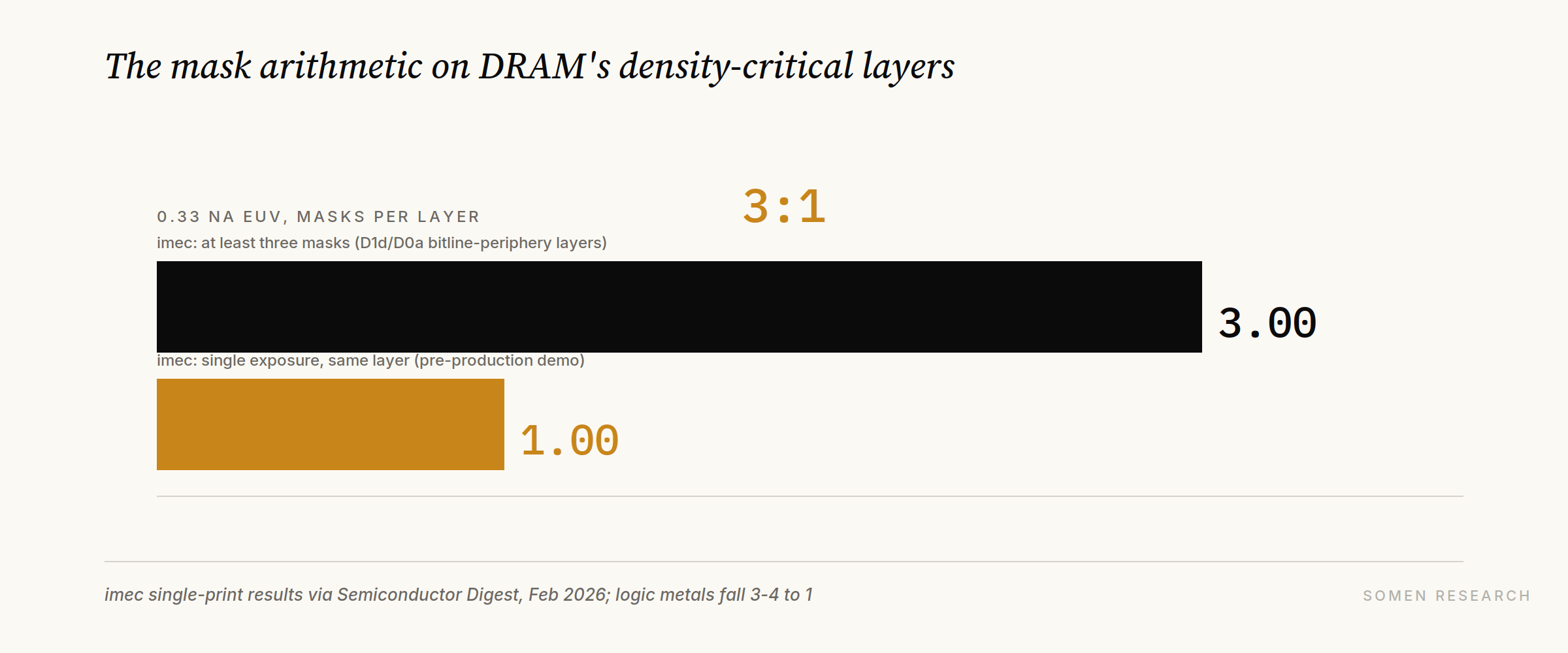
Why anyone pays double for the new machine: fewer steps. The layers that decide memory density need at least three masks on the standard machine and one exposure on High NA. That compression is the whole business case, and it is still a lab result, not a filed cost.
The wall. Chinese makers stockpiled about 230 of the older-generation machines before export law closed in. The EUV era was never available to them at any price. The next manufacturing standard is being set without them.
Dated falsifiers. Micron reports around late September; Samsung prints preliminary results around October 7; Apple’s own margin print follows. Any of them can move the read.
Why memory costs what it costs
Start with the seller’s quarter. Micron, fiscal Q3: revenue of $41.46 billion, up 346 percent year over year, gross margin 84.6 percent, with DRAM prices up roughly 60 percent in three months on almost no extra volume. A memory maker earning 84.6 percent gross is not a cycle. It is a shortage with a contract structure, and the structure is the striking part: 16 take-or-pay agreements running through 2030, about $100 billion in contracted minimums, $22 billion of customer deposits, and roughly 50 percent more demand than Micron can ship. Customers are prepaying for the privilege of being shorted.
The buyer has conceded in writing. NVIDIA, the largest buyer of all, reported quarterly gross margin of 75 percent, guided 74 percent, and pointed to a Q4 trough of 71 to 72 percent, explicitly on “extreme pricing conditions in memory”. The same week it warned its largest customers of 15 to 17 percent price increases on AI servers, while Korea’s customs data had DRAM export prices running some 400 percent above year-ago levels. The chain is visible: the memory makers charge NVIDIA, NVIDIA charges the cloud builders, and the cloud builders sign the take-or-pay deals that lock the shortage in place.
And the buyer is fighting back on more than price. In the same week as that margin concession, NVIDIA announced a memory design of its own: a custom base die, the traffic-controller chip inside each memory stack, claimed at 30 percent more bandwidth and 15 percent less power, buildable by multiple memory makers under a multiyear partnership with SK hynix. Korean reporting has Samsung building the first variant at 17 to 18 gigabits per second, a single-source figure. The geometry is blunt: NVIDIA pays the sellers’ prices with one hand and takes their design layer with the other.
Supply, not demand, is the constraint, and it is physical. The AI memory that matters, HBM, is ordinary DRAM die stacked 12 or 16 chips high and wired together; SK hynix has the 12-high version in volume production and the 16-high in customer qualification, sold through long-term agreements with roughly ten customers. One stack of it consumes roughly three times the wafer area, the silicon real estate, of ordinary memory chips; every stack built is three that do not exist for everything else. That is the mechanism behind the counter price in the lead, and behind the failed Chinese escape valve Apple went looking for.
Two cautions sit beside the consensus, and the first is really a bear case. TrendForce forecasts memory prices up another 50 to 140 percent into 2027, but the 2027 contract round has reportedly been stalled since spring while some cloud buyers trim orders. Pricing power this extreme invites demand destruction, and the three sellers are betting it holds through 2028. The cycle history says to be humble about that bet: memory is the most cyclical business in semiconductors, and every shortage in this young century has been answered by a supply wave and a price collapse. The claimed difference this time is the contract structure, the minimums and deposits above. And the supply side is already funded, not hypothetical: Hiroshima, Yongin, and a combined 800 trillion won program from the Korean majors alone.
The second caution is smaller: some of the good news is thinly sourced. Samsung’s HBM4 yield reportedly climbed from under 60 percent to 80 percent, Korean-press sourcing; one specialist tracker reports it passed NVIDIA qualification and entered volume shipping, which is single-source. Treat those as direction, not fact.
Three paths past 2027
For orientation: Samsung is the Korean conglomerate that makes memory and manufactures chips for others; SK hynix is the HBM leader and NVIDIA’s house supplier, the one most levered to the AI boom; Micron is the Boise, Idaho third seller, the most exposed to ordinary DRAM and flash. Together with China’s capped challengers, that is the entire advanced-memory industry.
The fork, strongest evidence first. (Node names differ by maker: Micron’s “1-gamma” and “1-delta” are its labels for what Samsung and SK hynix call “1b” and “1c.” Each step is one process generation.)
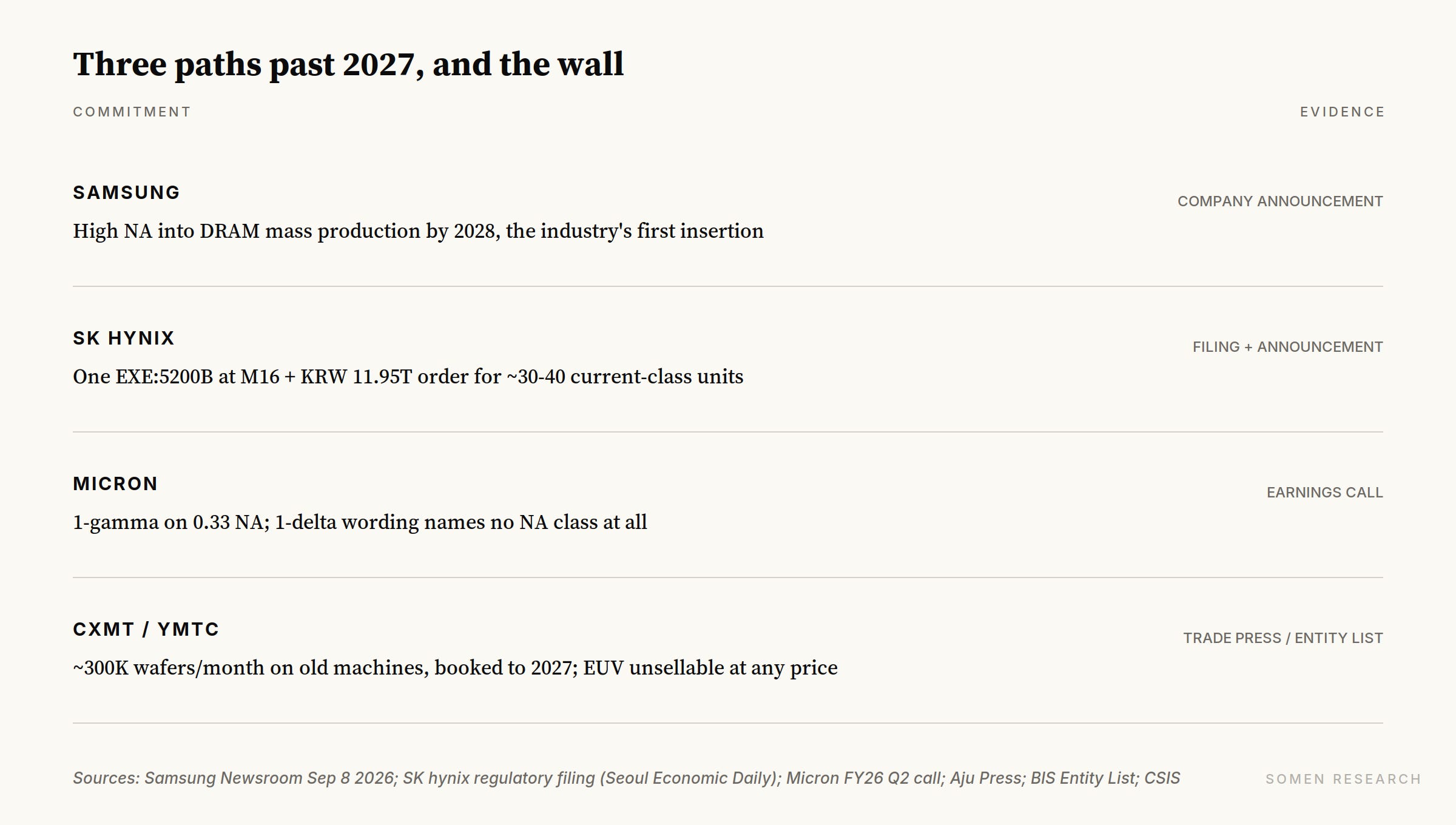
Samsung is the aggressive one, and the most legible: it runs memory and foundry logic both, and it has now put High NA on the memory roadmap with 2028 attached. Treat the date as a plan, not a filing. It is still more than either peer has put on paper.
SK hynix is the hedge, and the hedge is quantified in a filing. One High NA machine sits in its fab, the first any memory maker brought into production use. The 11.95 trillion won order buys roughly 30 to 40 of the standard machines through 2027, spread across its Icheon and Cheongju complexes and a new Yongin fab opening February 2027, with the stated purpose of accelerating its current-generation transition for the AI memory that pays the bills. One machine for the next era, a fleet for this one.
Korean reporting has its current-generation share rising from 10 percent of output early this year to a projected 34 percent by year-end. And the hedge carries a human tail risk the filings do not price: the union rejected its wage deal in August by 50.08 to 49.92 percent on 93.8 percent turnout. A company sold out through 2027 does not absorb a stoppage quietly.
Micron is the exception, and the exception is doing quiet work. Its production base is the current generation, its first EUV node, first to sample in February 2025, on track to be the majority of its output by mid-2026; it was the last major maker to adopt EUV at all. The only High NA connection anywhere in its record is a research center, named in its own New York fab release. Meanwhile the money flows to capacity, not frontier machinery: a roughly $9.3 billion expansion in Hiroshima, equipment arriving from late 2028, with up to one-third covered by Japanese subsidies. If you are reading the tea leaves: Micron is betting that sold-out current-generation capacity earns more before 2028 than an unproven machine earns after it.
None of the three is provably wrong. That is what makes it a fork rather than a leaderboard. The bets are not symmetric, though the prints will score them, not crown them. Samsung’s is the dated commitment: hardest to walk back, most exposed to the 2028 date, and the winner’s credential if High NA turns decisive on schedule. SK hynix’s is the balance-sheet bet: a fleet that pays off richly if the shortage runs and sits heavy if it does not. Micron’s abstention is the option position: it preserves capital and loses only in the world where High NA turns decisive quickly, which is the same world where its ambiguous wording becomes a liability. For allocation purposes the fork is the event: whoever picked right owns the cheaper cost curve after 2028, and the quarterly prints will show it one layer at a time.
What the expensive machine actually buys
Why pay roughly double for High NA? On the industry’s standard estimates rather than any published list price, the new machine costs at least 350 million euros, about twice the standard one. It also prints a smaller area per pass, so extra-large chips must be drawn in two passes that line up at the seam, dropping throughput from 175 to 125 wafers an hour, a penalty that bites the giant dies of AI processors, not the small dies of memory. Pay twice as much, print slower. The purchase only pencils if one pass of the new machine replaces several passes of the old one.
That is exactly what the research data says it does. A chip layer is drawn through a mask, effectively a stencil; more masks means more steps, more cost, more chances to go wrong. At imec, the Belgian lab where the industry rehearses next-generation manufacturing, the layers that decide memory density need at least three masks on the standard machine and print in a single exposure on High NA. That arithmetic is imec’s DRAM-roadmap work, with experiments confirming feasibility on those layers. The headline single-print demonstrations are logic-side, where three or four masks fall to one. Two caveats belong beside that: the single-exposure results are pre-production demonstrations, and a mask count becomes a cost only when someone publishes the layer-level accounting. Capability is demonstrated. Economics is pending.
The first napkin: SK hynix’s filing. 11.9497 trillion won at the per-machine figures in Korean coverage is roughly 30 to 40 machines, depending on the per-machine price assumed, against a fleet that the same coverage says roughly doubles. One order, a tenth of total assets, the fleet you already run, again. If the shortage runs through 2027, those are the cheapest machines it owns. If demand cracks first, the most expensive.
The second napkin: three masks to one. Take the lab arithmetic at face value and the density-critical layers lose two-thirds of their mask sets, exposures, and etch passes. Nobody outside the fabs knows the per-layer cost split, which is precisely why the fork is a bet rather than a calculation.
One clarification the headlines skip, beyond the stitching point above: memory dies are small, so what memory buys from the new machine is not a bigger print area; it is fewer steps. Which is also why this fork gets decided years before the industry’s next big format change, the 12-inch mask program announced the same week, pilot line 2031, production 2033with Intel, which has already run more than a million wafers through High NA, more than the rest of the industry combined, pushing it. Same bet, two timescales.
The wall
China’s memory program is the fourth path, and it ends differently.
Start with the results, because they are real. CXMT, which barely existed as a DRAM supplier when the decade started, told investors first-half revenue of 150.31 billion yuan, up 873.6 percent, at a 51.6 percent net margin and carries a market value around 3.7 trillion yuan, roughly $520 billion. YMTC is the world number three in NAND flash, the storage memory, at 14 percent share, with an irony attached: Samsung’s newest flash is now mass-produced with the stacking approach YMTC patented. The incumbent is scaling on the challenger’s architecture.
Now the constraint. CXMT runs an estimated 300,000 wafers a month across three fabs, with orders fully booked through the end of next year and local trade reporting targeting 500,000 a month by 2028, every wafer of it on the older machines. Neither company can buy EUV, the machine that draws everything after the current generation: an interagency process approved CXMT for the Entity List, the US export blacklist, in June, publication held; YMTC has been listed since December 2022. What they hold instead is the stockpile: about 230 of the older immersion machines bought across 2023 to 2025, roughly 70 percent of the maker’s 2024 shipments of that class, about $38 billion of tool imports in 2024 alone, by one estimate enough to cover roughly three years of expansion. The stockpile ends at the wall: EUV of any class was never sold to China, and the post-2027 roadmaps the Koreans are retooling for run on exactly the step count the old machines cannot reach. For scale: the three incumbents already run dozens of EUV machines between them, and SK hynix’s single March order adds 30 to 40 more; China holds zero and can lawfully buy zero.
The deeper risk is maintenance, not acquisition. A proposed US law, passed out of committee 44-0 but not enacted, would ban servicing of the installed machines alongside new sales; unserviced fleets degrade over 18 to 24 months. The maker’s own numbers show the door closing: China fell from 33 percent of its revenue in 2025 to 16 percent in the first half of 2026.
Apple found the wall from the other side. It tested CXMT’s phone memory as the escape valve, and the negotiation collapsed in August, per Korea’s Digital Daily, with CXMT quoting at or above Samsung and SK hynix prices. The China discount is dead: the squeezed buyer went looking for cheap memory and found a booked-out supplier asking Western prices. A bipartisan Senate letter with seven signatures demands Apple keep CXMT and YMTC memory out of every product. There is no cheap tier left on the planet, and the politics guarantee there will not be one.
The capped layer is nonetheless being financed at scale: CXMT’s July listing raised about $8.6 billion, the largest semiconductor offering in Chinese A-share history, and YMTC filed in August to raise about $4.9 billion, with the FT-relayed goal of becoming the world’s largest flash supplier by end-2027. Capital is flowing toward the wall. The wall has one door, and it is political: export controls are policy, not physics, and a negotiated loosening is the single event that redraws every count in this section. And the layer below the machines is closing too: the next mask standard is being set by ASML, TSMC, Intel, and Samsung with a supplier circle that redesigns every tool in the mask shop. In our data, four of the six companies in that layer are Japanese, the fifth is Intel’s Austrian subsidiary, the sixth American. China is not at the table and has no machine to print the masks for.
What would change the read
This is a structural read, not a prediction. The falsifiable version is on our public scorecard with a resolve-by of June 2027, and the near-term calendar is dense. The practical use is a watchlist, not a trade: the five dated events below each reprice a piece of the story within days of landing, memory capex, the litho supplier, or the China discount.
Micron, late September: any High NA mention in the call resolves the ambiguous wording in either direction.
Samsung, around October 7: capex attached to the 2028 date converts a press release into a spending plan, or fails to.
SK hynix, quarterly: the share trajectory of its current-generation output is the live test of whether the fleet order is converting.
The 2027 contract round: if it clears near the plus-50-to-140-percent forecasts, the shortage thesis extends; if materially below, the demand-crack reading wins and the insertion dates slip with it.
Apple’s own September-quarter gross margin, guided to 47-48 percent against the 50.1 it printed in June: the print tests whether the cost absorption is running hotter or colder than management’s own line, and the 2027 contract reset behind it removes the inventory cushion softening the blow.
Four ways the frame fails, named in advance:
Micron folds: if it commits to High NA before 2028, the abstention read was wrong and the fork collapses into a rush.
Samsung slides: if the date drifts toward 2030 without comment, the first-mover claim was positioning.
The roadmap sidesteps lithography: the unstated fourth road is Micron’s in effect, staying on the standard machines and competing on stacking, vertical transistors, and packaging, the directions that do not require a 350-million-euro printer. If cell design stalls or 3D stacking accelerates, High NA loses its purpose for memory no matter who committed.
The cycle turns: if AI capex rolls over, the fork inverts into an over-investment contest. Samsung’s dated commitment becomes the riskiest line on the board, Micron’s abstention becomes the prudent one, and the 30-to-40-machine order becomes the balance-sheet weight it mocked at signing.
The prints will tell, gradually rather than overnight.
Verification close
What is filed: SK hynix’s equipment purchase, Micron’s record quarter, YMTC’s listing paperwork. What is company-reported but unfiled: CXMT’s first-half results, Intel’s million-wafer count. What is announced but unfiled: Samsung’s 2028 date, every insertion plan, the 2031 and 2033 mask targets. What is demonstrated but unpriced: the lab’s single-exposure results. What is unknowable from outside: the layer-level cost accounting that would prove any one path right. The fork stands until the filings grade it, and the prints will score the bets one quarter at a time, not crown a winner overnight. When the next one lands, the desk re-runs the arithmetic.
If you want to check the work: Samsung and ASML | SK hynix machine | SK hynix filing | Micron node | imec | Micron quarter
Every number traces to a source. The analysis is ours. - The SOMEN Desk