


The bond market and the equity market are pricing the same GPUs two different ways, and the spec sheet settles it.
Sunday night the industry’s biggest borrower said the quiet part. SpaceX closed $40 billion of debt for GPUs - the largest GPU-collateralized raise on record - and Elon Musk explained why it worked: “we’re investment grade and have Starlink & launch [revenue].” His read on everyone else: debt markets have “almost entirely shut off access to money for any company that doesn’t have substantial revenue independent of AI data centers,” and “200+ neoclouds are going to see guppy-level death and consolidation.” The largest issuer just described the collateral clock in one sentence: the loans go to whoever does not need the GPUs to pay them back.
The short version
The replacement cost of one H100-equivalent of NVIDIA merchant compute halved roughly every 49 months across the merchant line: $38,058 in November 2020 (A100) to $17,019 in August 2025 (B300), per Epoch AI’s chip-cost estimates.
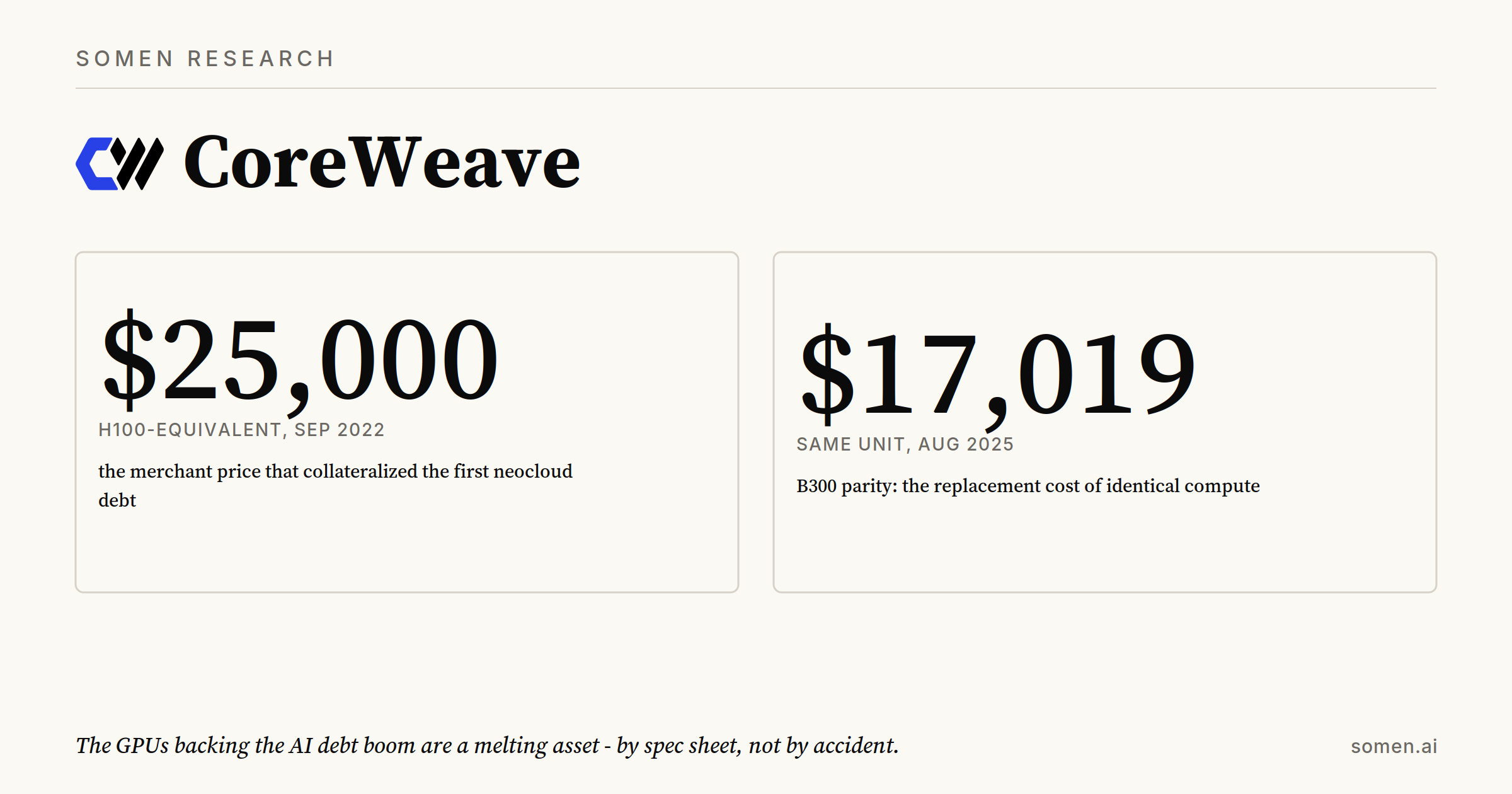
A fleet financed at H100 prices ($25,000 per H100-equivalent) is replaceable today at $17,019 - a 32% collateral haircut at replacement parity, before any second-hand discount.
CoreWeave trades at 1.2x the replacement cost of its installed fleet ($30.44B market cap vs $25.7B of campus capex). Nebius trades at 8.9x ($42.01B vs $4.7B).
Same asset class, same clock. One market has priced it. The other has not said which it believes.
The fork
The clock side. Pull the four merchant releases and divide price by compute. The A100, November 2020: $12,000 for 0.32 H100-equivalents - $38,058 per unit. The H100, September 2022: $25,000 for 1.0. The B200, February 2025: $37,000 for 2.5 - $14,645. The B300, August 2025: $43,000 for 2.5 - $17,019. That is 55% off over 57 months, a halving every 49 months - a rate fitted to four merchant price points, one of which rose, not a measured constant. The line is lumpy - B300 priced higher per unit than B200, memory costs riding in the package - so one step rose while the four-year trend fell by half.
Two footnotes sharpen it. Google’s TPU v8i, August 2026, carries an internal cost near $3,429 per H100-equivalent by the same estimates - the best customer’s own arithmetic prices the unit at a fifth of the merchant rate, which tells you most of the merchant price is margin, and margin is what a lender repossesses. And the CoreWeave 9.625% bonds of 2032 traded at a 14.8% yield at the Oct 14 read - a B+ credit paying a distressed-grade coupon into 2032, while the stock sits 61% below its fifty-two-week high of $141.79.
The market side. Epoch attributes 755,954 installed H100-equivalents and $25.7B of capital cost to CoreWeave’s campuses - about $34,000 per unit of compute in the ground, shells and power included. CoreWeave’s market cap is $30.44B. Divide: the market pays $40,268 per installed H100-equivalent, 1.2 times what the whole campus cost to build.
Nebius: 105,375 H100-equivalents, $4.7B of capex, market cap $42.01B - about $399,000 per unit, 8.9 times. Nscale, still private, carries a $14.6B round mark against $1.4B of tracked capex - call it ten times. The private round and the newest public fleet both assume the compute holds value; the oldest, biggest fleet is priced barely above the cost of replacing it.
Two honesty notes on those ratios: they are equity-only - market cap over capex - and CoreWeave carries the debt this piece is about, so its enterprise-value multiple sits meaningfully above 1.2x while Nebius’s cash pile against its new facility cuts the other way; and replacement cost is not collateral value - a lender repossesses into resale prices, rental demand, and remaining useful life, each of which can sit below the spec-sheet floor.
There is a counter-case, and it deserves its name. Silicon Data’s residual-value indices put the four-year-old H100 at 58-61% of purchase price this month - stickier than any melting-point arithmetic - and the B200 at 1.5x purchase under tight supply (VIG Asset Management, Oct 6, crediting Silicon Data).
Used chips trade on rental demand and scarcity, not spec sheets. But note where the two curves sit today: a used H100 at ~60% of $25,000 is ~$15,000, already BELOW the $17,019 it costs to buy equivalent new compute. The residual curve is stickier than the fitted halving - and the used market still prices old silicon under replacement parity. Both curves converge from opposite sides; the second-hand print is where the lender learns which one owns the collateral.
Both can be right only if the new fleets earn their premium before their own clock runs. A B300 bought today depreciates on the same curve the A100 did. This week the debt side kept arriving anyway: Nebius secured a $3.5B senior secured facility from Citi to fund the buildout - the same collateral class, one more layer deep.
The napkin
$25,000 bought one H100-equivalent in 2022. $17,019 buys it today.
Same compute. Same workloads. 32% cheaper, three years later, from the only vendor whose price anyone can check - and the discount compounds at every generation, halving roughly every 49 months.
A 2023-vintage fleet of 100,000 H100s carries about $2.5B of chips at cost. Re-priced at B300 parity, the same compute is $1.7B of silicon - a $800M haircut with every GPU still running perfectly. The collateral shrinks because the spec sheet advances, not because anything breaks.
Why it matters
The compute buildout is financed on the assumption that the asset underneath the debt is durable. Bernstein put CoreWeave’s funding gap near $85B last week; the bonds already trade like a restructuring case; and the equity of the youngest landlords still prices their fleets at eight to ten times the oldest one’s replacement cost. The clock says the difference between those multiples is not quality - it is age, and age is the one thing every fleet accumulates at the same rate.
For an allocator the read is structural, not a trade: the older the fleet, the closer the market prices it to the melting point; the newer the fleet, the more of its value is a bet on earning back the premium before the next release date - Nebius at 8.9 times replacement is that bet, trading today. The refinancings of 2027 - H100-era collateral, B300-era replacement prices - are where the two markets have to agree.
The falsifier
The clock ticks in public. Rubin’s release is dated September 30 per Epoch - almost exactly one half-life after the H100 (September 2022 to September 2026). Its merchant price is the test: below ~$12,500 per H100-equivalent, half of the H100’s $25,000, and the clock holds.
The first arithmetic is already in, as a desk derivation from Epoch’s spec columns and Morgan Stanley’s estimated unit price: VR200 carries 17.5 petaFLOPS of FP8 in Epoch’s table, which divides by the same 1.98-petaFLOP H100 baseline Epoch’s own conversions use into ~8.8 H100-equivalents per package - and Morgan Stanley’s $55,000 planned unit pricelands at roughly $6,200 per H100-equivalent: half the threshold, 3.5 times the B300’s compute for 1.28 times its price.
That read is only as good as the 8.8x conversion, which is a desk derivation from Epoch’s FP8 columns, not a benchmarked ratio - a workload-weighted 6x would put Rubin near $9,200 per H100-equivalent, still under the threshold but by half the margin. The clock holding, pending Epoch’s own priced row and any market print. Watch: Rubin’s merchant price; any second-hand H100 market print; CoreWeave’s Nov 9 earnings and any refinancing terms on the 2032s; Nebius’s Nov 10 print under the new Citi facility. Tracked on the public scorecard, resolve by June 30, 2027.
The second test is Musk’s own. “200+ neoclouds are going to see guppy-level death and consolidation. Some will make it through, but not many” is a dated, checkable claim against a set this desk tracks. Scored on the same ledger: consolidation, distress, or failure events across the neocloud universe by late 2027.
The collateral was never the buildings. It was a spec sheet with a release date.
Sources
Epoch AI - AI data centers (chip costs, installed H100e, capex; vintage Oct 25) - A100/H100/B200/B300 per-H100e costs, TPU v8i internal cost, CoreWeave/Nebius/Nscale installed compute and capital cost (CC BY 4.0)
Stock Analysis - CoreWeave (CRWV) - $30.44B market cap at ~$55.20, Oct 26 2026 close; 52-week range $53.50-$141.79; the Bernstein $85B funding-gap note in its Oct 23 news feed
Stock Analysis - Nebius (NBIS) - $42.01B market cap at ~$153.27, Oct 26 2026 close; 274.10M shares out
CNBC - CoreWeave stock and bond yields, Oct 14 2026 - the 9.625% 2032s at a 14.8% yield; S&P B+
Nebius - $3.5B Citi senior secured facility, Oct 22 2026 - the week’s new GPU-collateralized layer; Reuters coverage
Nscale - the $14.6B Series C mark - the private-side premium against $1.4B of tracked capex
CNBC - SpaceX closes $40B debt deal, Oct 25 2026 - Musk’s X posts verbatim: the investment-grade criterion, the debt-market shutdown claim, the guppy quote; SiliconANGLE’s transcription
Crusoe - Neuberger $700M power-infrastructure facility, Oct 22 2026 - the non-silicon collateral class
VIG Asset Management / Silicon Data - GPU residual values, Oct 6 2026 - H100 at 58% of purchase after four years (a mid-October read puts it at 61%), A100 at ~a quarter after six, B200 at 1.5x purchase under tight supply
Equity-print sensitivity: market-cap conventions vary across desks by a few billion dollars (share-count and timing); the ratios here re-derive on the cited stockanalysis prints and move within roughly 1.1-1.3x on any convention - the fork does not
Numbers derived from the SOMEN graph and the Oct 25 Epoch vintages at publication. The halving rate and all per-unit ratios are desk derivations from Epoch’s cost estimates - record the intervals, never flatten them. Per-unit costs are Epoch’s own per-H100-equivalent cost column at raw precision (A100 $38,057.69; B300 $17,019.40) - not division of the rounded package prices, which would give $37,500 and $17,200.