


Update, Aug 19: hours after publication Etched announced $700 million at a $21 billion valuation, led by Jane Street, which also signed as the first customer. The ticket widened: Kleiner Perkins, Tiger Global, Bain Capital Ventures, Neo, and Blackstone joined, the last also on NVIDIA’s compute-financing roster. The napkin has a sibling: $700 million into $21 billion is 3.3 percent. The original text stands; the arithmetic stands.
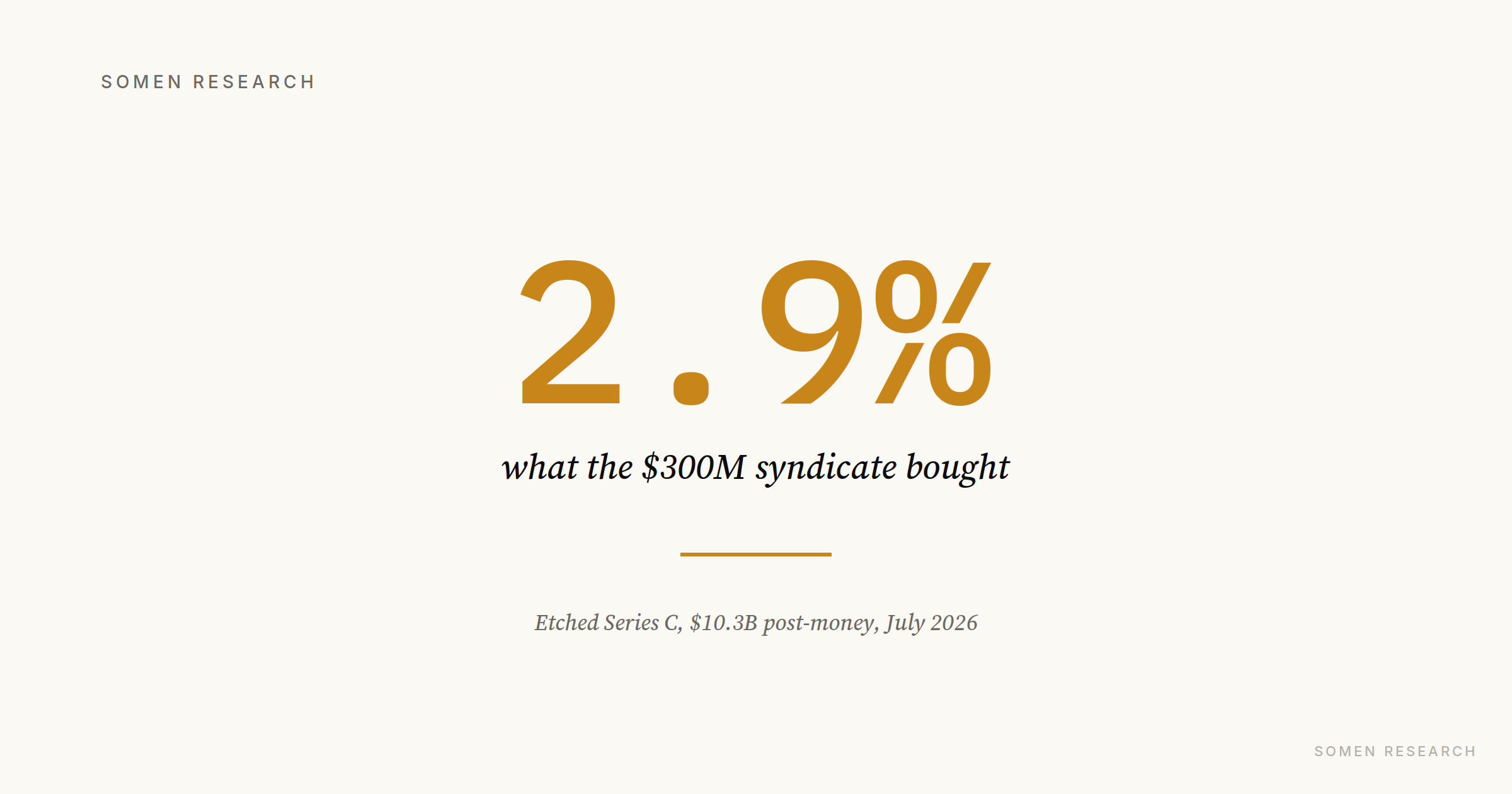
Etched says it closed a $300 million Series C at a $10.3 billion valuation, led by Sequoia Capital. Do the division the announcement implies: $300 million of new money into a $10.3 billion post-money buys the syndicate roughly 2.9 percent of the company, and that is the ceiling. Sequoia’s own announcement prices the round at $10 billion pre-money, which confirms the $10.3 billion as a post-money figure; if any part of the round was secondary, the new-money stake is smaller still. You can verify that on a napkin. For context, the desk’s rule of thumb is that a Series C lead alone takes 15 to 25 percent; here the entire syndicate, Sequoia through SK Hynix combined, bought a fraction of that. Sliver stakes are the 2026 norm at the top of the market, to be fair: SambaNova’s $1 billion bought its syndicate roughly nine percent, Groq’s $350 million about ten. The company’s own boast is that this is the highest valuation ever for a Sequoia-led Series C; the record-setting price and the record-thin stake are the same fact. The napkin’s point is narrower than rarity: Etched’s syndicate took the thinnest slice in the sector’s 2026 set, at the only company in that set with no shipped product. The valuation is a claim. The percentage is arithmetic, once its two assumptions are stated. When the two diverge this sharply, believe the arithmetic first, because the arithmetic cannot lobby you.
Several structures can explain a sliver round. The syndicate may simply have crowded: per the company’s own announcement, Sequoia appears alongside Andreessen Horowitz, Jane Street, Diffusion, Argo, and SK Hynix on the same ticket, and crowded rounds divide ownership until nobody carries underwriting weight. (Argo is the one name in that roster no other coverage carries, not even Sequoia’s own announcement of the round.) Part of the $300 million may be secondary, recycling existing shares rather than funding the buildout. Strategics may hold structured terms the press release does not describe. Either Sequoia accepted a rounding-error stake to print a headline number, or the round carries structure the announcement does not disclose. The data does not decompose it, and no share count is published anywhere we can find.
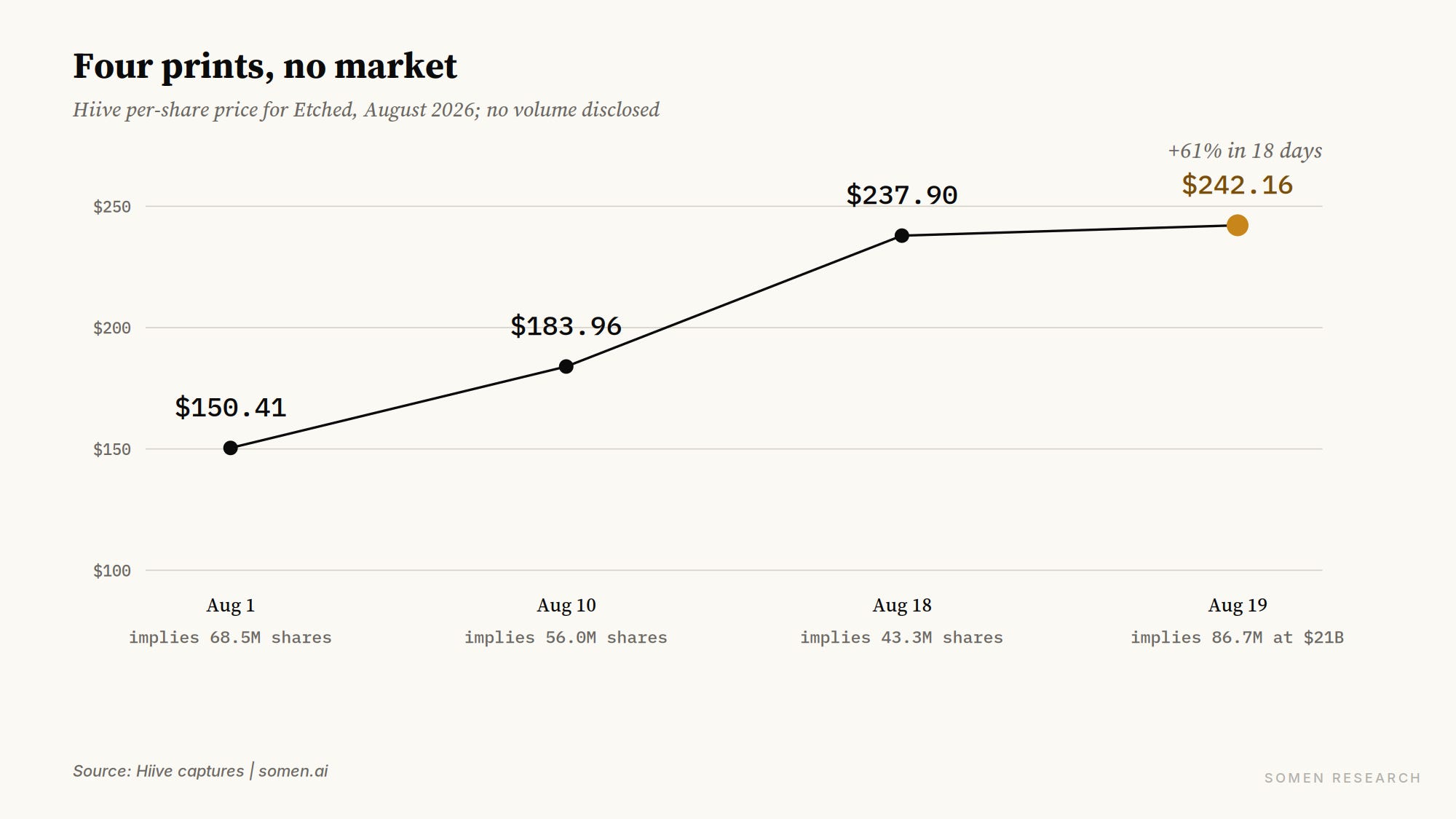
The secondary market will not arbitrage this for you. The tape has printed $150.41, $183.96, $237.90, and now $242.16, a 61 percent move across eighteen days of captures with no volume disclosed behind any of them. The reconciliation fork is the content: which share count is real decides what the prints meant. The August 10 print reconciles with the $10.3 billion mark at about 56 million shares. The August 18 print reconciles at about 43.3 million. A share count does not shrink by a quarter in eight days, so at most one print was fairly priced, and neither pins the cap table. Caveat in the same breath: whether the instrument changing hands on Hiive and the preferred stack the round priced are the same share class, there is no disclosure. A tape that swings this hard is not pricing the company. It is pricing the absence of a market.
The company’s own progress page describes a business at full boil: production underway against more than $1 billion in customer contracts, first racks promised “this summer”, A0 silicon back from TSMC, a Taiwan factory, and a new 10-megawatt lab in San Jose. Every item self-reported. But the verifiable data is not empty either: a live job board, a wage filing, granted patents, and a secondary tape. This piece walks the gap between the boil and the paper, and the napkin is the instrument throughout.
Our method: we treat company pages as claims and the trade tape, the funding ledger, the public code org, the job board and its 108 open roles, certified wage filings, and the patent record as evidence. Where the evidence is thin, we say so. Where it is absent, we say that louder.
Valuation: the tape against the headline
Start with what is stable and what is moving. The claimed valuation reads $10.3 billion on every capture of the progress page in our data, and claimed lifetime funding reads $800 million alongside it, unmoved across captures. Static numbers on a company page prove only that the page is stable. The tape already narrated above is the moving number, and two of its three prints cannot both have been right. When a thin tape moves 58 percent in seventeen days, the move is the finding: the prints are marking mood, not value.
A per-share price and a total valuation are different units, and reconciling them assumes facts the data lacks. If the Hiive instrument is common and the $10.3 billion claim prices preferred with liquidation preferences, the per-share price reflects that discount. If they are the same class, the tape confirms the valuation rather than contradicting it. The reconciliation is suggestive, not conclusive.
A secondary print has its own caveats, and this desk has likely given it too much benefit before now. Hiive reflects a small number of transactions between accredited investors, and a price without volume may not even be a cleared trade: it can be an indicative quote, asking a price nobody paid. The company’s $10.3 billion claim has a press release behind it. The tape has a market operator behind it. Neither has demonstrated size behind it. The tape’s edge is observability, not truth, and a 58 percent swing in seventeen days is a reminder of how little that observability currently buys.
Who is on each side of those prints, the record does not say, and the two sides tell different stories. A seller at $150 reads as an insider cashing out: an employee diversifying locked compensation, an angel rotating capital, a holder who needs liquidity more than conviction. A buyer at $237.90 reads as a party building a position on purpose. A deep market would contain both and meet in the middle; a tape of one motivated seller prints low, and one patient buyer prints high, which is what a 58 percent swing on no volume is. Which composition it is, Hiive does not disclose, and the composition is the story.
Then the number that is missing. The data contains no ARR for Etched. Not a range, not a bookings conversion, not a named account paying a named amount. The closest items are self-reported: more than $1 billion in customer contracts, a figure the same page elsewhere describes as “demand”. Contracts are not revenue. In hardware they are intentions with legal cover, and delivery slippage renegotiates them faster than any other instrument in the stack.
The next headline is already circulating. The Wall Street Journal has Etched in talks near $20 billion, per reporting relayed on the company’s own site, reportedly led by an existing investor. At that level the sliver logic compounds: each new round at a higher mark buys a smaller fraction, and a cap table marked in slivers is a cap table where price discovery has quietly stopped happening. A round is a fact when a filing says so. Everything before that is a report of talks. The report undershot: the round closed at $21 billion, the sliver logic compounded, $700 million buying 3.3 percent.
Funding: the ledger against the press release
The round ledger, as recorded: a $5.36 million seed led by Primary Venture Partners, 2023-03. A $120 million Series Aco-led by Primary Venture Partners and Positive Sum Ventures, 2024-06, disclosed alongside the TSMC fabrication partnership. A $500 million Series B led by Stripes at roughly a $5 billion post-money, 2025-12. A $300 million Series Cled by Sequoia Capital, 2026-07, at $10.3 billion. Four entries, clean progression, marquee names at every step. The least verifiable entry is the $500 million Series B, platform-sourced with no filing behind it anywhere in the data; the desk weights that one at fifty cents on the dollar. On August 18 the ledger gained a fifth entry: $700 million led by Jane Street at $21 billion. The named rounds now sum to roughly $1.63 billion against a lifetime claim of $1.9 billion: last week the ledger outran the claim; this week the claim outruns the ledger; the definition of “raised” remains the company’s.
The trajectory has two unusual features, and both are checkable. The seed-to-A step-up is 22x in round size, extraordinary and consistent with dramatic early technical progress. Then the rounds shrink: the Series C at $300 million is 40 percent smaller than the preceding $500 million round. In a normal trajectory, rounds grow. A shrink means one of three things: the company did not need the cash because revenue appeared (unlikely given no customer data); the valuation made equity too expensive to sell in volume (possible at $10.3 billion); or part of the round was secondary, meaning less new money entered than the headline suggests. The data does not say which.
Take the secondary possibility seriously on its own, because the surrounding facts earn it. The round shrank from $500 million to $300 million while the headline doubled, no filing exists to decompose the check, and a company letting insiders sell inside a growth round, at the richest price in its history, before first racks ship, is the classic late-stage configuration: founders and early employees taking liquidity while their own information about ship risk is better than yours. None of that is damning, and none of it is disclosed. If any part of the $300 million was secondary, the primary was smaller and the true new-money stake sits below 2.9 percent. The one number that would settle it, the primary-secondary split, is the one number nobody publishes.
Now do the reconciliation the company has not done. The progress page says Etched has raised $800 million across its financings. Add the ledger yourself: the four named rounds sum past $900 million, roughly $925 million, before counting the unannounced financings the same page claims, a strategic investment from VentureTech Alliance among them. Either the $800 million predates the Series C and the page is stale, or “raised” means something narrower than the ledger’s sum. A company marking itself at $10.3 billion should reconcile its own fundraising total in a sentence. It has not, and the coverage we reviewed did not ask.
Run the burn the claims imply, because runway arithmetic matters more than any multiple at this stage. Silicon talent in the Bay Area runs $350,000 to $450,000 a head fully loaded; the claimed 400 engineers imply $140 to $180 million a year in personnel alone, before tape-outs at $50 to $100 million per advanced node, the 10-megawatt lab, and the Taiwan factory. Call the total $250 to $350 million a year against $800 to $925 million raised. That is two to three and a half years of runway, one or two full tape-out cycles. The 108 open roles read differently against that arithmetic: not expansion on a comfortable bench, but the burn continuing, one more reason the fundraise schedule was never optional.
Two of the Series C participants deserve specific attention because they are not financial tourists. SK Hynix is a top-three global memory manufacturer. They make HBM, the high-bandwidth memory every advanced AI chip requires, and memory is the bottleneck asset in inference hardware. A memory maker funding an inference silicon company is purchasing demand visibility alongside returns: it validates the roadmap, not the price. Strategic money aligns incentives. It also prices strategically, on terms undisclosed. Jane Street is one of the largest quantitative trading firms in the world; they model risk for a living. What the data does not show is what their model bought, because quant desks price structure as readily as direction, and structure is exactly what this announcement does not disclose. A day later, structure with a name: Jane Street led the $700 million round and became the first customer, first rack in its datacenter, quote: “We tested the chip and are pleased with the early results.” One desk validated demand and price on a single ticket: stronger evidence the hardware works, weaker evidence the price is independent. Note also what the syndicate is not: no growth fund taking a board-shaping stake at size is identifiable in the record. The round was assembled, not underwritten.
And that matters for what the price certifies, because a strategic’s economics are not a common holder’s economics. Hynix’s payout is not only the mark-up on the shares: the seat buys HBM attach revenue, roadmap visibility, and a design-win relationship worth more to a memory maker than any multiple on the check. A strategic can rationally pay above fundamental value because it collects a side payment the common shareholder never sees. The same logic runs for any buyer pricing M&A optionality, the way NVIDIA priced $20 billion of optionality out of Groq. The syndicate clearing at $10.3 billion is not a certificate of the common’s worth. You do not receive the allocation economics, the supply leverage, or the option. Their all-in price and yours are different numbers wearing the same headline.
The angel roster is dense, and its core is externally confirmed: Hinton, Karpathy, Druckenmiller, Mensch, Thiel, Field, and Masad appear in outside coverage of the round, with the remainder, Dao and Abbeel among them, on the company’s own roster alone. Angel density says the idea circulates at the top of the field; it says nothing about price discipline. Small checks buy credibility; credibility is not capital at risk.
The comp set: priced like a story
Etched’s mark means something only against the set it prices with, so here is the desk’s peer table for inference silicon, marks refreshed to 2026 transactions where public sources exist:
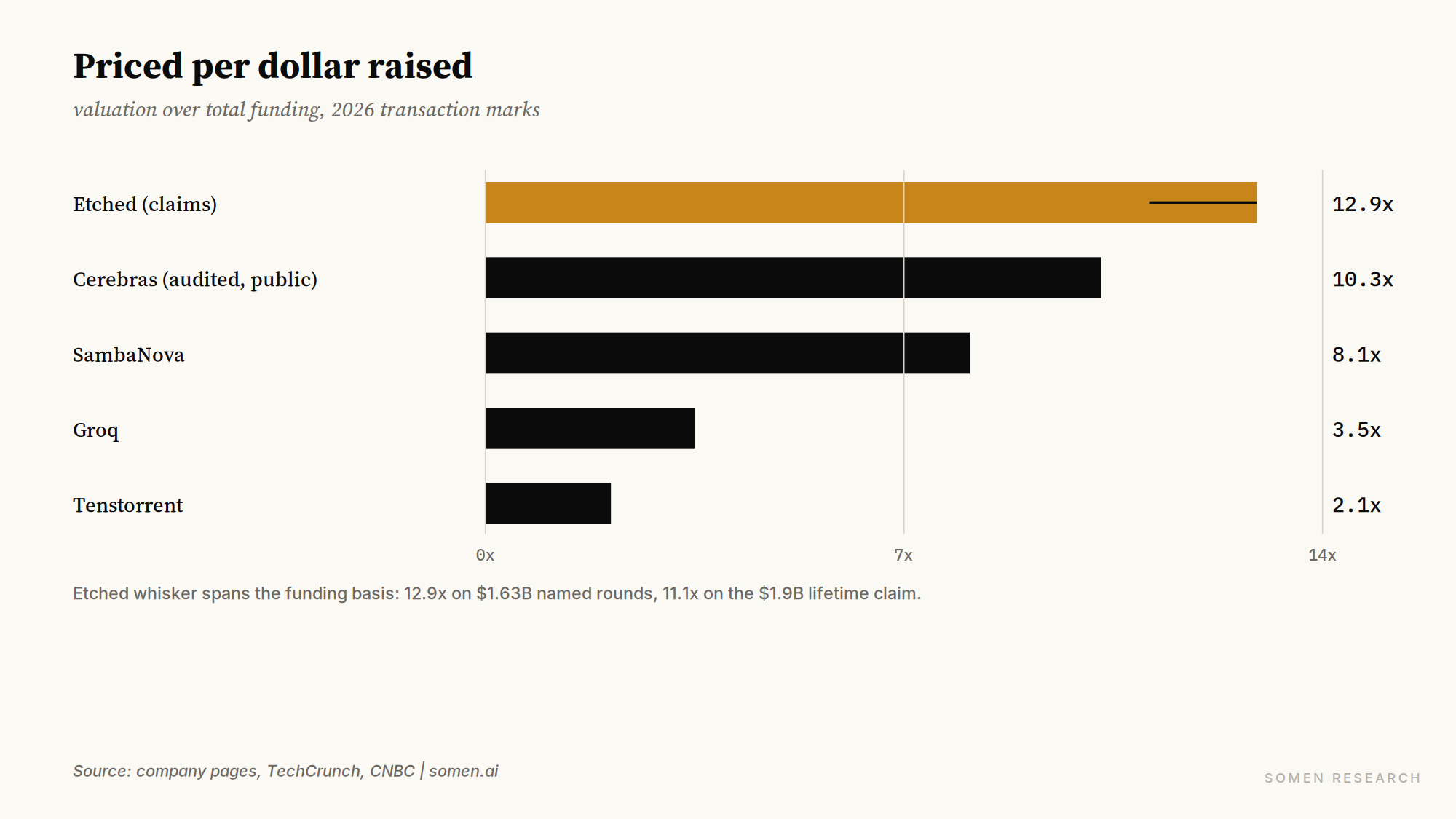
Every peer around Etched repriced in 2026, and every repricing carried evidence Etched does not have. Cerebras priced at $185 a share, closed its first Nasdaq session at $311.07 for a market cap near $95 billion, with audited numbers attached: $510 million of revenue, up 76 percent, $88 million of net income swung from a $481.6 million loss, and a prospectus that discloses 24 percent of revenue from G42, 62 percent from a single university. SambaNova is the closest analogue to Etched’s own arc: in December, Intel reportedly valued it around $1.6 billion in acquisition talks; seven months later it closed $1 billion at $11 billion, a near-sevenfold step on the same company, five months after a $350 million Series E launched alongside its SN50 chip. That repricing cuts both ways, and honesty requires both edges: it is the sector’s proof that the market will pay seven times over on narrative while the story is hot, which is precisely the bet Etched’s syndicate made at $10.3 billion, and it is a reminder that marks set on narrative reprice on the same narrative in the other direction, as the next company in this table spent the same year demonstrating. Groq’s 2026 was the whole lifecycle compressed: NVIDIA paid about $20 billion for its technology and its founder, against a $6.9 billion peak mark; the rump company re-emerged this month at $3.5 billion with NVIDIA itself joining the round, which the company calls a reset rather than a down round and the arithmetic calls half the peak.
Read the money multiples with that in view. Etched at roughly 12.9x named-round funding carries the richest mark-to-money ratio in the table, and the August step-up raised the mark and the ratio together: above 10.3x for a company trading with an audited income statement, above 8.1x and 3.5x for the privates, all of which shipped product before repricing. The market paid Cerebras-grade multiples only after revenue, profit, and a prospectus existed. Etched’s claim prices the outcome before the evidence, and sits alone between the evidence tier at $3 to $4 billion and the audited tier at $95 billion. That is the pattern, and the pattern is what a reader should price.
Tenstorrent is the row that settles the argument. Jim Keller’s company, last marked $3.2 billion in November after raising $800 million on top of a $693 million Series D, is reportedly sitting on roughly $150 million in customer contracts with Intel and Qualcomm circling as buyers. A decade-old silicon company with the industry’s most credentialed architect, real contracts, and strategic interest clears a third of Etched’s mark. Etched’s $1 billion in unnamed contracts, at the same evidence tier, carries three times the mark.
Give the bull case its full arithmetic, because it is coherent. If $1 billion in contracts converts into revenue and holds, a $10.3 billion mark is about 10x revenue, against the 186x the public market just paid for Cerebras’s audited $510 million. On that math Etched is the cheap name in the sector. The private set offers no revenue multiple to check against, because none of the privates discloses revenue anymore, and that absence is itself the second finding: the sector stopped disclosing ARR in the same year its marks ran furthest ahead of it.
And the bull case has assets the arithmetic alone does not carry. NVIDIA paid $20 billion for Groq’s technology and its founder, one inference architecture, at the end of last year; Etched’s entire company, factory and bench and contracts included, is marked at half that. If strategic buyers price inference silicon, the sector already printed a floor at double this mark. Sequoia’s participation, likewise, is evidence that a dataroom existed and was read by someone whose job is pricing risk; per the company, the round’s investors are people who actually tried the hardware, and Sequoia has published its thesis in its own words, calling Etched “the machine that builds the machine” and claiming “Pareto dominant performance on industry-standard throughput-interactivity curves.” That is the bull case’s full shape: plausible, priced, and unverifiable from outside, the exact mirror of the case above. The reader’s job, and this desk’s, is to notice that the price already assumes the bull version. The entire defense hangs on the conversion. Peer ARR figures are reported revenue. Etched’s figure is a promise with signature blocks, no named buyer, no disclosed terms, no schedule. You can believe the conversion. You cannot yet verify any piece of it.
One honesty note on the table. Every mark is a 2026 transaction except Tenstorrent’s, which is its November private round pending the strategic outcome; Cerebras now trades daily, so its cell moves with the market. The ARR column is thin by design, not by oversight: SambaNova’s last recorded figure predates its SN50 and both 2026 rounds; Groq’s most-quoted number was a target it never booked; Tenstorrent discloses none. One basis note: the funding cells carry what the cited articles report, which for SambaNova, Groq, and Tenstorrent is their 2026 rounds rather than lifetime totals, so their multiples run on recent money; on lifetime totals all three sit lower, which only widens the gap the table shows. The specific multiples are directional. The qualitative gap, Etched at zero disclosed revenue while every peer has shipped, holds regardless of which exact numbers you use.
Traction and hiring: the checkable edges
Start with who is actually named in the record, because the list is short and entirely upstream. TSMC as fabrication partner. Rambus for HBM memory-controller IP and integration support. Both are suppliers with names. Downstream, where customers live, the data is silent: the $1 billion in contracts attaches to no buyer, no segment, no disclosed terms. The page’s phrasing is “co-design decisions made hand-in-hand with leading AI companies, cloud providers, and hyperscalers”, which is a customer list with the names removed, and the removal is the information.
Hiring is the checkable edge, and it is informative. The job board lists 108 open roles: Software at 29, ASIC at 23, Platform at 20, Production at 14, Operations behind those. The sample titles tell more than the counts: design verification engineer, physical design engineer, PCB layout engineer, infrastructure software engineer, a technical recruiter pointed at supercomputing and machine-learning talent. Design verification engineers are hired when you are preparing to send a chip to the fab. Physical design engineers implement the layout. PCB layout engineers design the board the chip sits on. This is an implementation-phase pattern, not an architecture-phase one. You do not hire PCB layout engineers for a concept.
The ASIC-to-Software split, 23 to 29 out of the 108 open roles, is notable on its own. For a company whose differentiation is hardware, more open software roles than chip-design roles suggests significant inference-serving infrastructure behind the silicon: schedulers, kernel drivers, performance profiling. That is consistent with the co-design claim, and it means the public evidence, while thin, is at least internally consistent.
The locations carry the same signal: 91 of the 108 roles sit in San Jose, 10 in Taipei where the foundry’s fabs are, and 6 in Austin, an outpost the data does not explain. Staffing manufacturing operations next to the fab is supply-chain proximity you can count.
The federal labor-certification data runs the other way. Certified LCA filings in the wage database: a lone electrical engineer petition, 2025-Q3, San Jose, at $217,630. Set that beside the claimed 400 engineers and the possible readings are that the team is overwhelmingly domestic hires, plausible for senior silicon talent, or that the headline count runs ahead of the roster, also plausible. What the lone filing does establish is tier: wage level IV, the top H-1B band, at or above the 90th percentile for the role in the metro, a senior hire’s paperwork rather than a bargain one. On count the data cannot distinguish, and the desk declines to guess. What remains is narrow: the foreign-worker paper trail is thin against the claimed headcount.
The public code surface is small and mostly beside the point: 13 repositories and 2,122 stars across the org. The recorded gap between claimed engineers and accumulated stars, 430.5 percent, compares a payroll number to a popularity contest, a category mismatch for a hardware firm whose crown jewels are RTL and interconnect specifications rather than public repos.
The patent record: three granted
The company’s own patent policy page lists three granted U.S. patents, 12,306,903, 12,361,091, and 12,361,262, plus published applications including US20240378175A1, “Multi-Chip Systolic Arrays”. The portfolio as described covers matrix multiplication, tensor operations, and systolic array architecture, the core of an inference ASIC. Not an empty file cabinet.
One note, because the method cuts both ways. The page is self-reported, the class of claim this desk holds at a discount, but patent numbers are also the one kind of claim a reader can verify against the issuing office in minutes, which is why the correction stands on it. Scale it honestly at the same time: three granted patents is modest relative to a $10.3 billionvaluation in a sector where established incumbents hold portfolios in the dozens or hundreds. The read here is “early-stage IP, actively expanding”.
Three claims, three locked doors
The terms of service are standard for pre-release hardware evaluations. Every chip company with an early-access program has an NDA. That is not the finding. The finding is the parallel:
Valuation: $10.3 billion claimed. No filing anywhere in the data; the price exists on the company’s own pages alone.
Contracts: over $1 billion claimed. Customers unnamed, bound by confidentiality.
Performance: SOTA claimed. Etched’s own terms state, verbatim: “Published Performance Data may be based on extrapolations, projections, estimates, simulations, or limited testing data, and may represent expected or anticipated performance rather than actual measured results under all conditions.”
Three claims, three verification gaps, each structured so the claim cannot be checked from outside. Valuation has no filing because none of these rounds ever produced one. Contracts have no names because customers are bound by confidentiality. Performance has no benchmark because the terms prohibit it and the hardware may be pre-release anyway. The information architecture is one-way: Etched can publish anything, and no one else can publish anything at all. “Early customer tests show SOTA throughput” is a claim only Etched can make and only Etched can verify. When the lawyers and the marketers share a page, believe the lawyers. They are the ones with exposure.
The position
This is not a company selling vaporware. The evidence points to a real hardware company: a credible team drawn from NVIDIA, Google TPUs, Broadcom, SK Hynix, and TSMC, serious investors including a strategic memory manufacturer and a quantitative trading firm, an implementation-phase hiring pattern, three granted patents, and fabrication claims consistent with the role mix. Those are not the attributes of a slide deck.
The pedigree runs to the top of it. Uberti worked compiler and AI-model performance at OctoML and left Harvard as an undergraduate to found the company; compiler optimization for inference is the exact skill set a custom-ASIC strategy runs on. The dropout origin story is a character marker, not a technical guarantee. It demonstrates conviction, not competence.
The question is whether the evidence justifies the same tier as companies that have crossed the product, revenue, and customer lines. The 2.9 percent Series C stake means sophisticated investors accepted a small ownership slice at a high price. The round shrank from $500 million to $300 million while the valuation doubled. And the absence of any public benchmark or named end customer is the sharpest difference between Etched and its valuation peers. The hardware industry routinely prices design wins that have not yet converted to purchase orders; the design wins here are real in pattern but unnamed in the record.
The desk’s allocation answer, stated as structure rather than prediction: a secondary purchase at the market price, never the round. This month complicated the cheap half of that sentence: at the share count that reconciled the August 10 print, the latest tape, $237.90, values the company at roughly $13.3 billion, a premium to the claimed mark, so the tape is no longer the obviously cheaper instrument. It remains the observable one, and observable is the honest word for it: no preferences, no lockups, a price you can watch even when you cannot acquire size, and a volatility that discounts its own prints. The round buys preferred with rights the tape does not carry and a stake size the tape cannot sell you. The narrative’s cost here is not a price gap. It is the ownership gap: 2.9 percent at most, for the entire syndicate combined, against the 15 to 25 percent a lone lead ordinarily takes. The buyer of the narrative should pay that cost, not you.
What changes the calculus
Three things would shift the picture.
A benchmark. If Etched published its chip running a standard transformer workload at a specific throughput and power envelope, the market would have something concrete to price. One number would do more to validate or undermine the $10.3 billion than any investor signal. Note the constraint: the terms of service make this the only path. Evaluation customers cannot publish results, so a third-party benchmark requires Etched’s consent or a breach of contract. The picture changes only when Etched permits it.
A named end customer. Not TSMC the foundry. Not Rambus the IP licensor. A company committed to buying Etched’s chip at a specific volume and price. One named buyer would shift the risk calculus entirely. The $1 billion in contracts is a number on a company page; a named buyer is a number with a signature behind it. The confidentiality terms mean the name appears only if Etched lets it appear. Resolved, Aug 19: Jane Street, on the round’s lead ticket.
The share count. If the fully diluted count is near 56 million, the August 10 print reconciled and the latest print implies the market already pays a premium to the round. If it is near 43 million, the latest print reconciles and the earlier prints were discount marks. If it is neither, both readings are wrong. That data point’s absence is structural. The new round prices a third count into the fork: $242.16, the print after the announcement, reconciles $21 billion at roughly 87 million shares. Three prints, three counts, no disclosure.
Two of the three arrived within a day: a named customer and testimony in place of silence, both wearing the same name. The share count still gates the price, and the relationship between $21 billion claimed and $242.16 traded is an open question the public record does not answer, and Etched’s legal framework keeps open. The percentages survive either way, as ceilings: Sequoia’s 2.9 percent, Jane Street’s 3.3 percent, one division each, and every unanswered structural question can only shrink them. Everything above is annotation.
How to verify
If you want to check the work: progress page | terms of service | patent policy | Hiive | funding record | investor page | code org | job board with 108 roles | wage database. Start with the napkin: $300 million into $10.3 billion is roughly 2.9 percent of the company.
Every number traces to a source. The analysis is ours. - The SOMEN Desk