


The short version. NVIDIA’s own quarterly filing carries $366 billion of total future commitments and, separately, $108.5 billion of maximum guarantee exposure. One of the largest single coherent GPU fleets ran at about 11 percent model-FLOPs utilization - the share of the math a chip could theoretically do that training work actually uses, a software-efficiency result and not idle silicon. Different paper on different sides of this market: the $366 billion mixes instruments, and only its supply-purchase lines may be canceled, rescheduled, or adjusted before firm orders; guarantees pay only on a trigger; take-or-pay is the tenants’ form, signed faster than the compute is being delivered, mostly in paper that is not filed anywhere. The whole ledger, one row per number:
Every number in this piece sits in that table, in the references at the end, or in a napkin. The prose carries only the ones the argument collapses without.
In August, NVIDIA filed a 10-Q carrying $366 billion of total future commitments - supply agreements, cloud capacity, leases, equity - and the instruments do not share one set of walk rights: only the supply-purchase lines may be canceled, rescheduled, or adjusted before firm orders. Separately, and mostly not yet effective, sits the guarantee stack: a maximum gross exposure of $108.5 billion, of which $105 billion is capped at a single campus, SB Energy’s PORTS in Pike County, Ohio, occupied by an OpenAI affiliate.
The instrument is named in NVIDIA’s own August filing: residual value guaranties, a form borrowed from commercial real estate. The chipmaker guarantees the long-lived layer - land, power, and shell - and sells the short-lived one: the campus hosts NVIDIA compute exclusively, hardware that refreshes several times across a twenty-year lease.
The mechanics are as soft as paper gets. Exposure takes effect only as halls come online, declines as rent is paid, and pays nothing unless a trigger fires - OpenAI insolvency or failure to pay. Even then it pays only a shortfall. OpenAI reimburses what NVIDIA actually pays, and the whole structure terminates the day OpenAI earns a satisfactory credit rating.
Read the design and the purpose is plain: OpenAI is private and unrated, so it borrows NVIDIA’s balance sheet to make a twenty-year lease creditworthy. And note the elegant loop in the reimbursement term - the guarantee pays exactly when the counterparty reimbursing it has just failed.
That is the supply side, filed. The demand side lives in press releases and unnamed-source stories, and it is enormous: Anthropic alone signed roughly $107 billion of compute deals in about ninety days - $144 billion only if the one cancellable monthly line runs its full term. Published tallies of its 2026 commitments range from a quarter to nearly half a trillion dollars depending on which deals the counter includes, and none of the tallies is the market. The filings will say which.
The utilization side is barely measured at all. In May, The Information reported that xAI’s fleet of roughly 550,000 GPUs was achieving about 11 percent model-FLOPs utilization, against 43 and 46 percent at Meta and Google on the same metric. An internal memo obtained by Business Insider confirmed the figure, and the company’s president called it, verbatim, embarrassingly low.
A market where sellers file $366 billion of commitments and the one public efficiency datapoint reads 11 percent looks less like supply and demand than like credit. That reading is this desk’s frame, not a finding: the efficiency report was about software, and one lab’s stack does not grade the take-or-pay book - it grades cost per useful chip-hour for that tenant, if the memo is right. But whatever the frame, the market’s paper is a ledger of promises, graded by who filed what.
Where the guarantees live
The 10-Q commitments table is NVIDIA as underwriter. The company does not just sell accelerators; it guarantees leases, backstops data centers, and signs its own cloud agreements on top.
Above the filing sits the platform NVIDIA announced in August: memoranda of understanding with six Wall Street namesto mobilize more than $500 billion of third-party capital for AI compute. BlackRock’s Larry Fink, on the announcement panel: “the very beginning, like what it was when I started in the mortgage-backed securities market in the 1970s. And I look upon this as a next future for financial engineering.”
NVIDIA coordinates the capital, connects private equity to its own customers, holds an option to backstop up to a quarter of projects, and collects the chip purchases as revenue. The capital funds the customers; the customers buy the chips; the chip purchases are NVIDIA’s revenue. Fink’s mortgage-backed comparison was not a slip. It is the term sheet.
NVIDIA is not the only chipmaker running this play, and the second instance is more leveraged. Broadcom’s AI XPV does the same thing one layer over: debt that buys Broadcom racks, leased to frontier labs, with Broadcom’s own 10-Q capping the first-deployment backstop near $29 billion, nothing yet paid under it, and a syndicate now gathering $60 billion more - current reporting, not a closed facility. These numbers are not forecasts of chip demand. They are debt secured on the expectation of chip demand, repaid by leases guaranteed by the chipmaker whose chips the debt buys.
And the buyers are building platforms too. In August, Anthropic, Macquarie Asset Management and GIC announced Theseus Infrastructure, a dedicated data-center platform with Anthropic as anchor tenant and the asset managers supplying majority equity. No figures were disclosed anywhere. The structure is the fact: the market’s largest tenant helped found its own landlord, because the lease commitments got too large to keep renting from strangers.
Who rents from whom
The demand ledger is best read as one company’s ninety days.
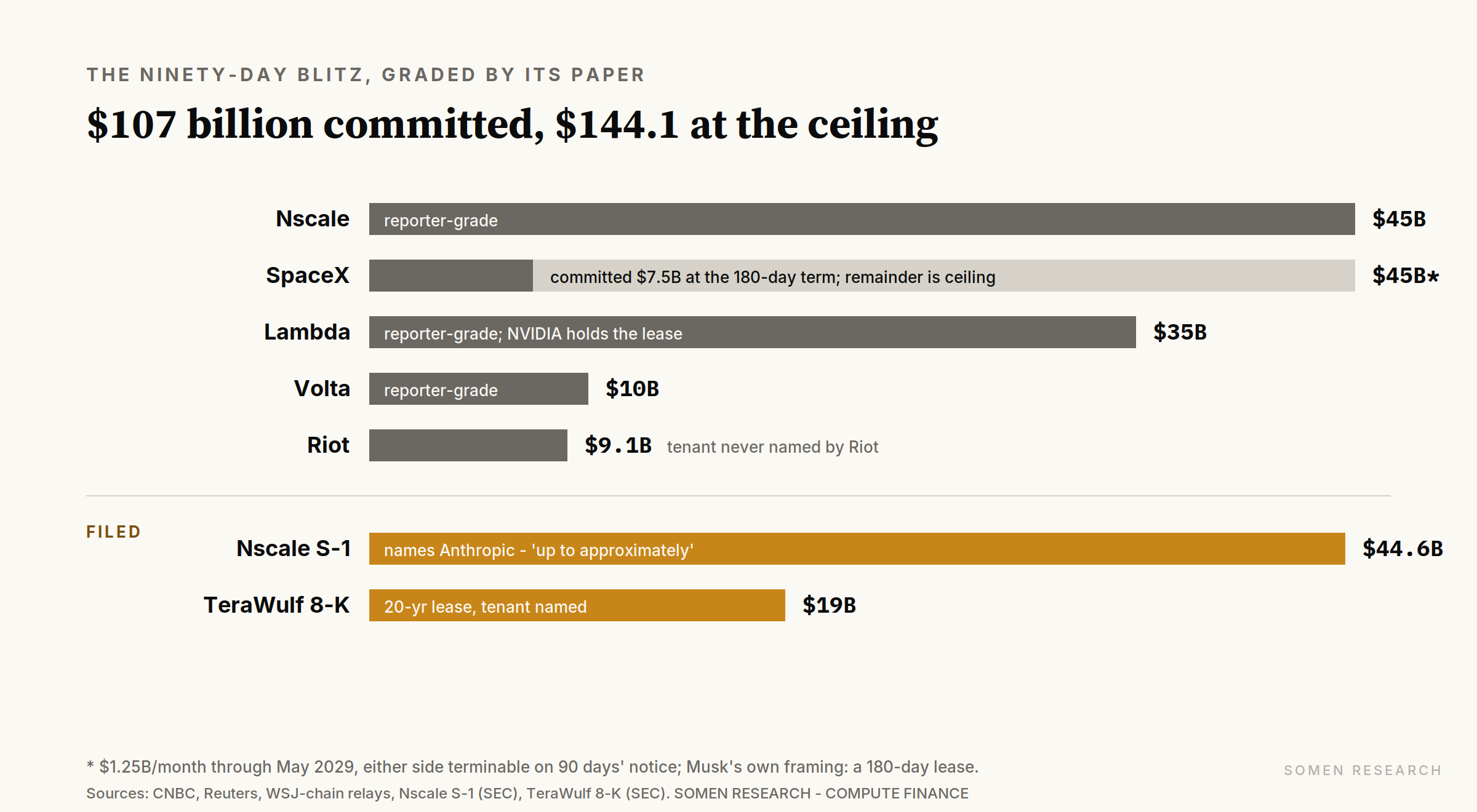
Anthropic’s blitz, mid-year: five deals, five landlords, every one reporter-grade. A West Virginia campus with Nscale. A Memphis cluster via SpaceX. A converted bitcoin-mining site in Texas with Riot. A Norwegian campus with Volta. A Texas site with Lambda whose lease NVIDIA itself holds - the chain runs miner-developer to chipmaker-landlord to cloud-operator. The full itemization, with every term the desk could verify, sits in the references.
The SpaceX leg is the softest large dollar in the ledger, so label it before counting it: a monthly rate through May 2029, terminable by either side on ninety days’ notice - and Musk’s own description was a 180-day lease with cancellation after that. An initial-term ceiling near $7.5 billion, not a committed $45 billion. The sum above carries both tenors.
Notice who the landlords are. Riot pivoted from bitcoin mining. Volta’s first deployment sits on Bitdeer’s Norwegian campus. Nscale was built on a bitcoin-mining group’s hydro site. Crusoe started in stranded-gas bitcoin. They came from crypto because they already held the asset this market prizes most - permission to pull serious power from the grid. A miner’s site is a data center with the hard part already done.
Grade the same ledger by what is actually filed, and three landlord filings carry Anthropic lines: TeraWulf’s July 8-K on a twenty-year lease with renewal options, SpaceX’s own IPO paperwork confirming the monthly line, and Nscale’s S-1 - the largest of the three, and the next section’s subject. Riot has never named its tenant in its own disclosure; Bloomberg did. Three lines are the filing-grade ledger. Everything else with a nine-or-ten-figure number in it is a press release or a sourced story.
The filed version of a compute contract is also where you can read the walk rights. The Google-SpaceX agreement is an SEC filing, and it terminates on ninety days’ notice, with Google holding an exit right if delivery slips. Filed does not mean short - TeraWulf’s filed lease runs twenty years. Filed means you can read the walk rights. The unfiled versions are described, by the people selling them, as twenty-year take-or-pay, and their walk rights are unreadable.
What the tenants’ own paperwork says
Take-or-pay migrated from LNG terminals into memory chips and then into compute, and it is now the standard form on both sides of this market. What makes the moment unusual is that two of the tenants have filed documents, and the filings do not describe the press releases.
Nscale’s S-1 is the cleanest example. The company that signed a $45 billion deal with Anthropic filed total contract value of $103.4 billion against $2.6 billion of active contracts - and the gap is the whole story.
The napkin. $103.4 billion of contracted value; $2.6 billion of contracts in force. The active paper is 2.5 percent of the total. The arithmetic cannot lobby you.
The exhibits show how the credit actually works. The Anthropic agreements sit inside four Delaware special-purpose vehicles - shell companies set up to hold the contracts. No fees are payable for a tranche of capacity until Anthropic’s written acceptance of it. Late delivery carries a termination right with no payment and no liability. There is no termination-for-convenience clause - no walking away because you changed your mind.
And the customer grants the provider the right to pledge the agreements and the receivables - the money it is owed - to its project lenders, with direct agreements preserving the lenders’ right to step in and take over if the provider fails.
Read that last clause again - it is the financing model in one sentence. The provider borrows against the customer’s signature. Anthropic’s contract is not just a revenue line; it is the collateral in somebody else’s credit facility. Multiply that structure across the backlog and the take-or-pay clause stops being commercial boilerplate. It is the load-bearing wall of a debt stack.
And the walk risk is not hypothetical. OpenAI, the announced initial offtaker for Stargate Norway, never concluded the offtake and stepped back; Microsoft absorbed the capacity. No one booked a loss; the site found a new tenant; the story moved on. Every take-or-pay ledger in this market carries that option, usually without the ninety-day notice.
What does an 11 percent fleet actually mean
Start with what the number is not, because the misreading is everywhere. Model-FLOPs utilization is the share of the math a chip could theoretically do that a training run - the work of teaching a model - actually uses. The rest is lost to waiting on data movement and communication between chips, while the chips themselves run hot. It is a software-stack efficiency metric. Eleven percent does not mean 89 percent of the GPUs sit idle; it means the stack wrapped around them converts about a ninth of their theoretical peak into training work.
The Information’s own translation was an “imperfect analogy”: effective compute like about 60,000 GPUs on the ~550,000 fleet. An analogy, labeled as one - not a census of idle silicon. The comparison set matters too. Nobody runs at 100; the physics of coordinating hundreds of thousands of chips guarantees losses, and production-grade training typically lands between 35 and 45 percent. Coverage was explicit that xAI’s hardware deployment is best-in-class and the losses live in the stack. It is a spread: the best operators extract roughly four times the delivered compute from the same chip-hour that the newest mega-fleet does.
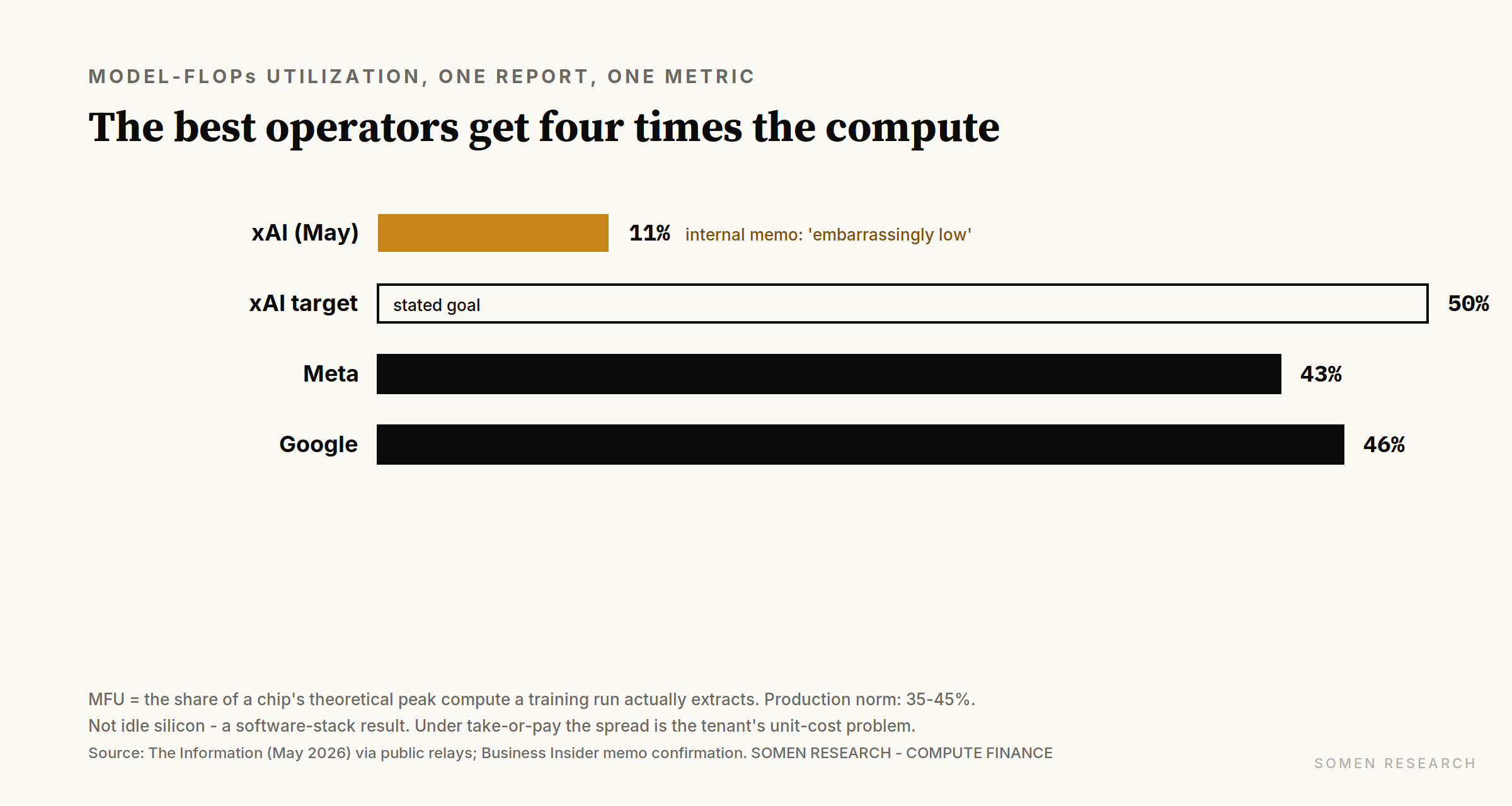
Why does that belong in a piece about credit? Because under take-or-pay the landlord’s debt service runs on the contract, not on utilization. The efficiency cost lands on the tenant: the same committed dollar buys a quarter of the useful work the best operators extract. Carried long enough, that is what makes a tenant stare at a take-or-pay ledger and ask which line it walks first.
The napkin. 11 percent against 43 to 46 on the same metric: the best operators get about four times the delivered compute from the same chip-hour. Under take-or-pay that spread is the tenant’s unit-cost problem - and the leading indicator of who walks first.
The escape valve is already open: xAI began renting surplus capacity externally - Cursor training its latest model on tens of thousands of xAI GPUs, per Business Insider. Musk’s stated plan is gigawatts growing sevenfold by late 2027, and SpaceX’s hosting portfolio is the same answer: surplus capacity becomes a landlord’s inventory. Watch the rental pricing - the market’s real utilization view prints there first.
The sellers’ own prints argue demand is real - Micron guided supply-demand much tighter through fiscal 2027 and 2028, with customers prepaying to secure supply - but demand being real does not make delivered compute real. Contracted capacity and useful output are separated by a software stack, and that separation is where the financing risk lives.
The demand side is now pitching the same future on the record: 2028 revenue in the hundreds of billions, a pre-IPO credit facility in the tens of billions, and an IPO reported for as soon as mid-November - a target that has already slipped once in the sourcing, with investor meetings reported from October 14. The commitments ledger and the revenue pitch are the same document read twice: the take-or-pay rungs are the collateral for the projection.
Chips as collateral, and the seller’s twin
The frontier of the credit market is now below the data center, at the chip itself. General Compute, founded in 2025 with a team under ten people, runs an inference cloud - it rents out chips for running trained models rather than building them. It signed an up-to-$400 million debt facility billed as the first with inference chips as collateral, drew on it for a Cerebras agreement the company calls its largest hardware commitment, and took over its first six megawatts in Texas. The lender is also a shareholder.
The established end of the same market now prints investment grade: on October 1 Lambda closed a $1 billion senior-secured, fixed-rate term loan - drawn in stages as deployments come online - marketed to insurance companies and fixed-income investors. When insurers are the buyers, the collateral is no longer venture paper.
The same contract form binds the market one layer down, in memory, and there the seller files. Micron’s September print: 26 Strategic Customer Agreements, all take-or-pay, extending into 2031, with customer financial commitments in the tens of billions, the vast majority cash deposits - three distinct measures, kept apart in the references.
The buyer side of that architecture is the compute ledger you have just read: the same labs, the same years, the same clause. Memory’s version is filed because memory’s sellers are public and their auditors demand it. Compute’s is not, because nearly all of its landlords are private. The asymmetry is the story: when obligations are real enough to file, they get filed. Most of this market is not there yet.
Where the loss lands
A structural read owes the allocator one more table: not what happens, but who is standing where when it does.
Delivered compute stays thin while contracts hold. The tenants pay take-or-pay, so the landlords’ debt service is met, and the loss is absorbed invisibly as cost per useful chip-hour at every AI lab. The public sees none of it. The tell is the efficiency spread, which is why one eleven-percent datapoint is worth a hundred press releases.
Demand cracks and a contract reopens. The prepayments burn first - Micron’s deposits, a fifth of contract value at Nscale, whatever unwritten floors sit under the unfiled deals. Then the guaranties trigger, paying only the shortfall, with NVIDIA’s reimbursement claim resting on the counterparty that just failed. The providers’ project lenders follow, holding receivables from a tenant that walked. The Stargate Norway exit is the precedent: nobody filed a loss, the site found a new tenant, and the story moved on. Scale that gracefully.
The IPO window opens and stays open. Then none of the above happens on paper, because the commitments are refinanced into public equity at marks the private rounds set. The mid-November filing window is the transfer mechanism for the entire private ledger: after the S-1, the take-or-pay rungs, the prepayment terms, and the utilization assumptions all become public-document facts, gradable by anyone. The promises stop being promotional the day they are filed.
What would falsify this read
Dated, checkable, and none of them require anyone’s opinion. Is any of it priced in? This desk reads structure, not prices - the falsifier list is the position: when one lands, the repricing happens whether the market saw it coming or not.
NVIDIA’s Q3, November 18. The commitments and guarantee lines move or they do not. A flat guarantee line after a quarter of new platforms would be the single most informative datapoint of the season.
Anthropic’s S-1, expected as soon as mid-November. The compute-commitments note grades the desk’s tallies and every reporter-grade deal in the ledger at filing grade.
xAI’s MFU progress toward its 50 percent target, or a rental price for surplus capacity. Either the spread closes and the same fleet supports multiples of the May work, or the rental market prices what the stack cannot extract.
Nscale’s first post-listing quarter. Bookings against a $103.4 billion backlog, on a public clock - the first test of whether a neocloud’s filed backlog converts to active contracts at a rate that justifies the buildout.
A walk. One more Stargate-Norway-class exit re-prices the prepayment layer everywhere.
References and numbers
Every figure the prose left out, with its source. Numbers here are load-bearing for lookups, not for reading.
The filed supply side. Commitments breakdown and guarantee stack per the 10-Q: $120B remainder-of-FY27 / $100B FY28 / $98B FY29; $279B supply-and-capacity within it, up from $119B one quarter earlier; a further $56B of cloud agreements and uncommenced leases; option on roughly 3.8 more gigawatts at PORTS (“the filing’s own rounding”); first halls expected calendar 2028 / fiscal 2029. The residual value guaranties 8-K exhibit in full.
The ninety-day blitz, itemized. Nscale: $45B, six years, ~460MW, West Virginia. Riot: $9.1B, twenty years, 191MW, Rockdale TX, to June 2048. Volta: $10B, six years, Norway. Lambda: $35B, Texas - tenor widely reported as six years is a borrowed prior, not a disclosed term. SpaceX: $1.25B/month through May 2029, both Colossus campuses, 325,000+ GPUs, 90-day mutual termination; sum arithmetic 45 + 45 + 9.1 + 10 + 35 = $144.1B at full ceiling, $106.6B committed-tenor.
The tallies. One census counts five 2026 deals above $275B with AWS in the set; another carries roughly $254B confirmed, ~$454B with the reported $200B Google web; reporters quoting Anthropic’s confidential IPO paperwork put the April Google-Broadcom TPU agreement at a $125.2B five-year commitment - not public on EDGAR.
The hyperscaler layer. Over $100B with AWS over ten years, Amazon investing $5B now and up to $20B more; $30B with Microsoft Azure plus up to a gigawatt of NVIDIA systems, Microsoft and NVIDIA investing $5B and $10B; $50B toward Fluidstack-developed US sites, Google backstopping the leases for warrants.
The filed demand anchors. TeraWulf 8-K: ~$19B, twenty years, 401MW, two five-year renewals, investment-grade credit “expected.” Google-SpaceX FW filing: $920M/month October 2026 through June 2029, ~110,000 GPUs, 90-day termination after December 31, delivery exit right. SpaceX CFO portfolio: $3.43B/month across four tenants (the two smallest lines are the softest inputs); the new $1.11B/month tenant, identity undisclosed.
Nscale’s S-1, beyond the napkin. H1-2026 revenue $140.6M against a $1.02B net loss; RPO $56.4B at June 30; prepayment 23 percent of contract value; Anthropic agreements named at “up to approximately $44.6 billion”, acceptance-gated; Aker’s half-year report notes all material projects remain in development.
Micron’s three measures. Customer financial commitments $32B, vast majority deposits; deposits on balance sheet $12.7B after a quarter taking in $12.3B; RPO ~$150B on the call’s count; even at floor prices, margins above any prior cycle peak (call).
Broadcom’s AI XPV. 10-Q: initial $35B tranche, >1GW deployed, >20GW aimed through 2028, ~$29B backstop cap undiscounted, $42B convertible-note ceiling (separate, undrawn). October package per Bloomberg: $42B senior + $18B Blackstone-led junior, $9B Blackstone own funds. Bank of America’s $370B is a 2029 forecast, not a borrowing.
The efficiency report. xAI ~550,000 H100/H200 across Memphis and Colossus; effective-compute analogy ~60,000 GPUs; Meta 43 / Google 46 on the same metric; production norm 35-45 percent; xAI target 50 (the report’s public carriers).
Anthropic’s IPO window. 2028 revenue pitched at $190-200B; pre-IPO revolver above $10B; raise reported above $100B.
Every number above is drawn from the desk’s graph, where each fact carries its source, date, and evidence grade. Where two published totals disagree, both are stated; the filings will settle which, starting in November. The track record for every claim in this series sits on the public scorecard, with falsifiers and resolve-by dates, because a structural read that cannot be checked is just a mood.
- The SOMEN Desk