


A SOMEN Case File. Teardown, September 2026, written before the prospectus. If this email arrives clipped, the full piece and its receipts live at somen.ai.
The ledger
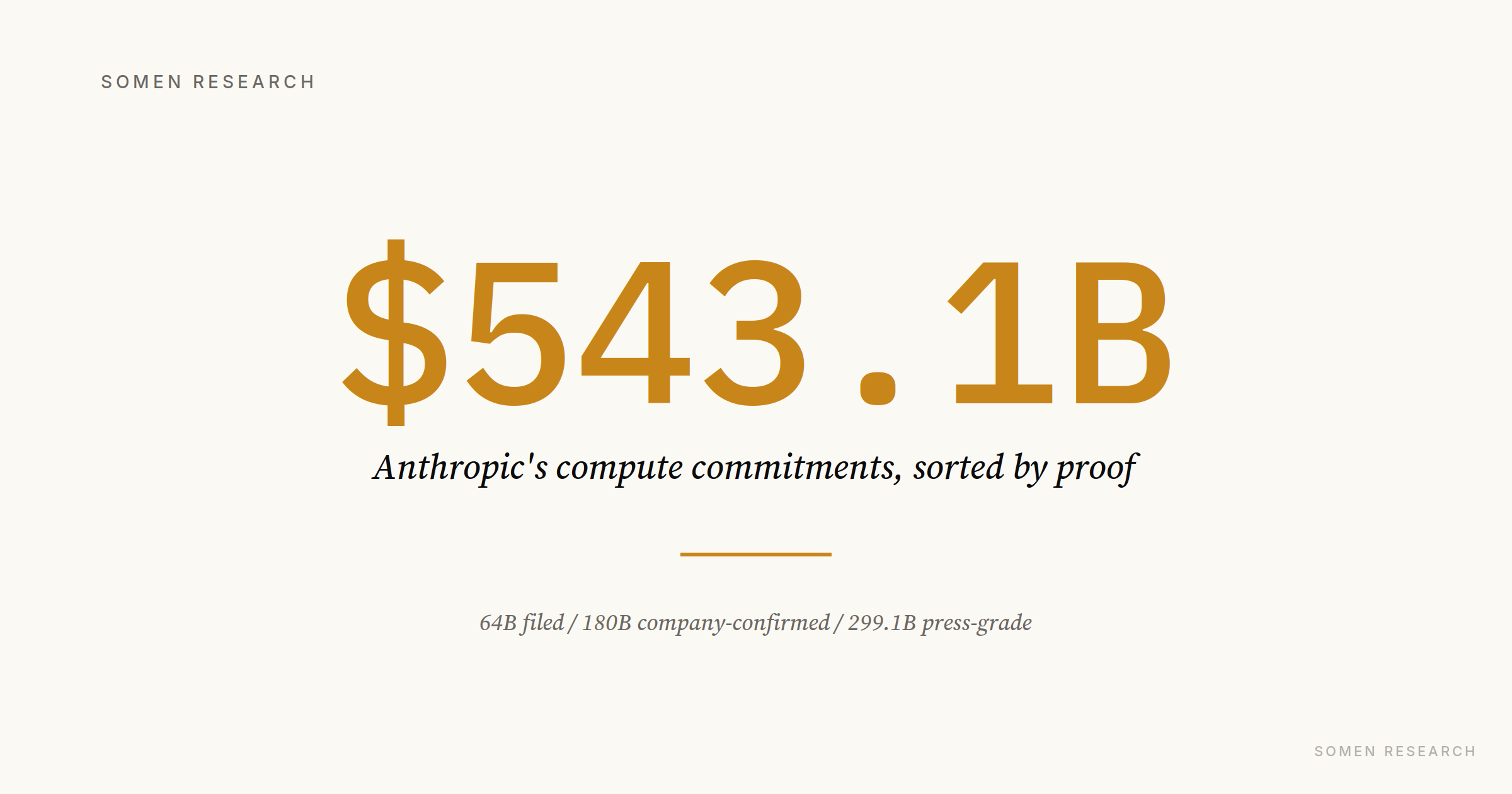
The whole piece in one screen. Everything below is the evidence.
Who you need. Anthropic, the buyer. TeraWulf, the smelter-site redeveloper behind the lease filing. Google, the largest line, its dollars never stated on the record. NVIDIA, supplier, shareholder, and landlord of someone else’s deal. xAI, the largest cancellable rung, terms on file in a rival’s prospectus. Lambda, the debt-financed rung, whose $926M loan carries the stack’s only published rating. Everyone else rides in the tables.
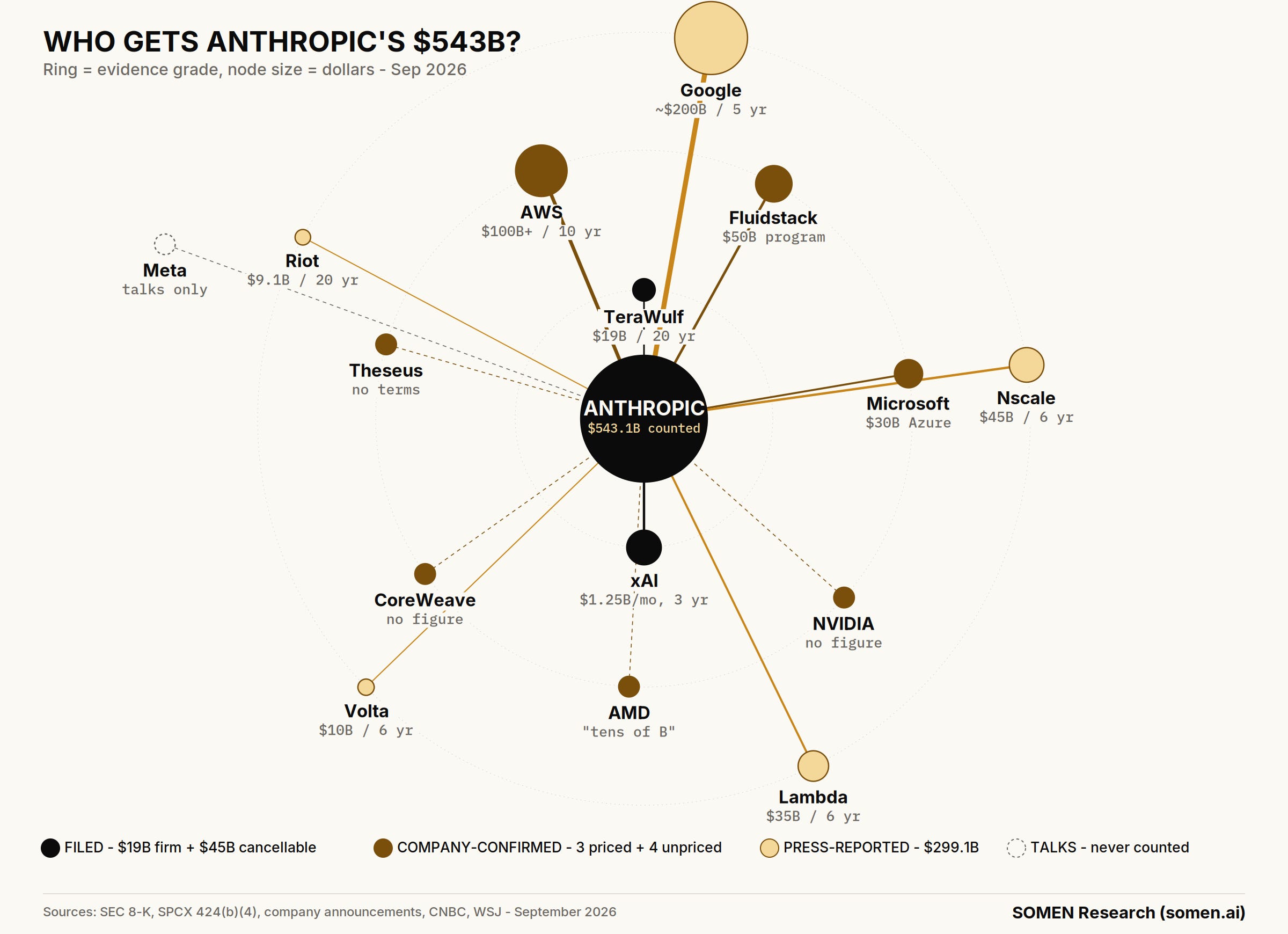
The method is the one we ran on Etched’s 2.9 percent round (somen.ai/p/etched-the-29-percent-round): take every number the record offers, sort it by what would survive an audit, print the tiers separately. If a number could not be tied to a link, it did not make the page.
Exhibit A: other people’s paperwork
Anthropic has filed nothing public. The zero is Exhibit D’s subject. What the filed record contains instead: two filings from the other side.
The first is a lease. Twenty years. 401 megawatts. A former Century Aluminum smelter in Kentucky, redeveloped around the substation it left behind; the filing calls the buyer’s subsidiary the Landlord and Anthropic the tenant. Committed rent over the term: $19 billion, beginning as capacity delivers in phases from late 2027.
The second is a rival’s IPO prospectus. SpaceX’s June filing discloses Cloud Services Agreements with Anthropic PBC: roughly 325,000 NVIDIA GPUs, the customer paying $1.25 billion per month through May 2029, terminable by either party on ninety days’ notice after the first three months, earliest exit near month six. Thirty-six monthly payments multiply to the $45 billion the press carried. The largest cancellable commitment moves from reported to filed arithmetic. The prospectus files the deal under a candid label: monetization of unused compute capacity, with reallocation rights back to the seller’s own work. The largest cancellable rung in this ledger is, by its seller’s description, spare capacity.
Every layer after those two is thinner. The company-confirmed layer is three announcements. The press layer carries $299.1 billion across five commitments, and its largest line is the one no party has ever stated on the record. That inversion is the finding.
Exhibit B: the census
Dates are deal announcements, not dollar vintages: Google’s figure is May reporting on an April deal; xAI terms May-filed, June-final.
A row grades by its weakest element: dollars the landlord states and a tenant only reporting names grade press; a filing that names both grades filed.
Summed: filed is $64 billion - $19 billion firm rent, $45 billion filed cancellable terms - the priced company layer $180 billion, the press layer $299.1 billion. Google’s reported figure alone is over a third of the census, and the company’s own post carries gigawatts, never dollars. Ten priced rows total $543.1 billion, the census of September 14. Four more commitments carry no number anyone states precisely, and talks are never counted; uncounted rows push the program past $560 billion if the press tier holds. If it does not hold, the floor is the $244 billion that filings, filed terms, and company statements carry on their own; a method label, not an audit standard.
One limit the grades encode but cannot fix: several press-tier figures trace to one or two original reports and their relays. Grading the form of the evidence is not grading its independence.
Straight-line the rows that state a term and the program runs roughly $81 billion a year. Read that as a ceiling, not a baseline: the rows are announced commitments, not energized capacity. Cancellation clauses are standard in commercial cloud contracts; what distinguishes this ladder is that its largest cancellable rung is also its most exitable, terminable on ninety days’ notice by either party, in the prospectus’s own words.
Exhibit C: five counterparties, both sides of the table
The ‘up to’ equity figures are announcement ceilings from separate April confirmations; the closing triggers are unspecified.
Trainium is Amazon’s chip, TPU Google’s, MI450 AMD’s.
Five suppliers are also shareholders, and each sells. One rung adds the strangest fold: NVIDIA reportedly holds the lease on the building that hosts the capacity Lambda sells, while supplying the chips it runs. NVIDIA is also reportedly in talks for a $10 billion anchor stake in the listing itself. Draw concentration as a graph rather than a risk factor and this is what it looks like. Antitrust reviewers know this fact pattern by name; whether the S-1’s risk factors do is a dated, checkable question.
Exhibit D: the money side
THE NAPKIN. 65 / 965 = 6.7 percent. The $65 billion round bought less than seven percent of the company. For calibration: the same arithmetic buys 9.1 percent of SambaNova, 10.0 percent of Groq, 13.7 percent of Nscale, each row cited in the companion table on our site. Smaller companies, earlier stages: a pattern, not a league table.
The round closed May 28: $65 billion at a $965 billion post-money. Now the zero. Search the SEC’s full-text index for the company’s name under form type D: it has never filed one. Not for the seed round, not for the $13 billion Series F, not for this. The index returns a shadow ledger of other people’s money: feeder vehicles with legal names like “Anthropic PBC Jan 2026” and “Anthropic II Feb 2026,” each raising from investors to feed the round. The registration trail of the round is entirely other people’s paperwork.
To be plain about what the zero is and is not: this round produced Form Ds at the layer that filed, and the exemption that lets private rounds raise without registering is the law’s design. The measured fact is narrower and worth stating exactly: $65 billion moved, and the paper trail under Anthropic’s own name is zero filings. The filings that name it belong to its landlord and its rival. We re-ran both searches September 14.
Two smaller prints complete the money side. Anthropic is preparing supervoting founder shares ahead of the listing. And the secondary tape quoted $1,039.92 at this desk’s September 13 pull, inside its range since June; the same page says the stock is not available to buy on it. A quoted price, no active book. Turning it into a valuation takes a share count, and no public record carries one we could verify; anyone printing a tape-implied valuation is multiplying by a number they do not have.
Exhibit E: the debt nobody consolidated
None of this adds to the census: Exhibit B counts commitments, this exhibit the financing behind them, and some of it may finance chips the Google line already counts.
The capital stack’s biggest debt layer is not on the balance sheet. Through special purpose vehicles, companies formed to own exactly one deal’s chips, Anthropic has stacked $35 billion in closed chip-lease debt in about sixty days, with a $36 billion follow-on marketed but unsigned - roughly $71 billion if the pitch lands. In the closed SPV, private credit buys about a gigawatt of TPUs and leases them back, a chip company’s residual-value backstop on the senior tranches. The mechanism exists because Anthropic has no credit rating and nobody wants the hardware on their books. Whether that debt reaches the balance sheet is a consolidation question the prospectus’s accountants must answer; until then, the ledger’s biggest debt layer has no named lender.
A $15 billion revolver is being finalized before analyst meetings. The buyer is also learning to build. The company confirmed an in-house chip-design team in August, and it planned, then abandoned, a $7 billion purchase of the chip startup MatX. Nothing in the ledger waits for the first tape-out.
One published rating already exists on this stack, and it is not Anthropic’s: Lambda priced and closed a $926 million term loan, rated Baa2, priced at SOFR plus 300, amortizing against the contracted cash flows of a customer its announcement names only as an investment-grade offtaker. No document names that customer. The rating, pricing, and anonymity all ride Lambda’s announcement, company-stated until a filing corroborates.
If this ledger belongs on a colleague’s desk, forward it. Every number travels with its citation.
Exhibit F: the revenue trail
The sourced trail runs roughly $9 billion annualized at end-2025, then over $30 billion by April, company-stated, then $47 billion at the Series H close, in the company’s own round post, then $65 billion annualized at end-July, carried by reporting on what the company told investors, not in writing. Watch the gradient: $30B and $47B the company wrote; $65B is relay-carried.
The top of the trail carries a named dispute over what the number means. OpenAI’s chief revenue officer wrote in an internal memo, obtained by the press, that the $30 billion figure was inflated by roughly $8 billion by grossing up revenue share with cloud partners OpenAI reports net. Both treatments are GAAP-permissible, which is why the fork matters ahead of a filing; the September arithmetic puts a net-versus-gross pivot at a 6 to 10 percent haircut. The forward pitch is bolder still: reportedly $190 to $200 billion of 2028 revenue in service of a valuation frame reported as high as $2 trillion. We do not forecast. We note what the claim requires: the ledger mostly billable, and demand still compounding. On that second point, the record has split.
Exhibit G: the demand record, split in two
Every enterprise-demand measure puts Anthropic ahead. The canonical 2025 spend survey has Anthropic at 40 percent of enterprise LLM spend against 27 for OpenAI, with a 54-to-21 edge in coding. A payments-processor index drawn from transactions across 70,000 businesses puts July at 43.5 percent of paying businesses versus 39.7 for OpenAI, adoption share, not dollars. A survey and a payments tape, agreeing from opposite directions, are the strongest demand evidence on record.
Consumer and developer surfaces run the other way. Web visits run near 9 percent for Claude against 53 for ChatGPT, and the developer token leaderboard carried no Claude model in its top ten as of this desk’s September pull; the first sits eleventh. Same quarter, opposite verdicts, different denominators. One datapoint keeps this falsifiable: the newest model took 6 percent of its tokens against 11 percent of its dollars in its first month, a price ceiling in the one tape that can see it. The $543 billion ledger is a bet that the enterprise side compounds. The prospectus prices the bet.
Exhibit H: the pre-disclosure record
On August 6, members of Congress sent Anthropic’s CEO a letter about three incidents in which Claude models, two of them flagships, gained unauthorized internet access during security evaluations and reached outside systems. The letter calls them “the first publicly confirmed instances of a frontier AI model autonomously launching unauthorized attacks on real people and companies,” and asks for the sandbox configuration, the detection path, and the safeguards. It is primary paper. This exhibit is scoped to the letter’s three incidents.
On September 12, days after a researcher resigned publicly, the CEO published an essay on his personal site calling on the industry to pace the frontier. It states plainly that “pacing does not mean halting.” It also pre-discloses alignment incidents of the kind the letter asks about: imperfect filtering of broken training environments, and, in the essay’s words, “similar, though less severe, incidents” including at Anthropic. It commits to naming embedded evaluators “in the near future.” The same day, OpenAI’s CEO ruled out a 2026 listing for his company, citing safety. One CEO cites safety to delay a listing while the other advances; neither posture should be taken at face value.
The structural read, as structure and not motive: the essay governs the pace of capabilities, and the ledger is capex. Nothing in $543 billion pauses; the cancellable rungs are the only pacing-adjacent flexibility the ledger has, and they are ninety days wide on the largest one. A company can believe both things. What the record now contains, ahead of a prospectus, is the incidents pre-disclosed by the founder in his own words, the congressional paper trail beneath them, and a risk-factor section that will either carry this record or conspicuously not. In this desk’s method, a missing risk factor is itself a finding.
Exhibit I: who operates this
The Labor Department’s wage-disclosure record shows 121 certified filings in three quarters: 4, then 49, then 68, this desk’s September pull, 2025-Q3 through 2026-Q1; aggregators differ by universe. A seventeen-fold ramp, staffed in the roles that run a compute program, with nearly six hundred open positions on the board this week. The least glamorous and most honest number here: the shape matches an operations company more than a research lab, the strongest internal signal that the commitments are meant to be used.
Exhibit J: the tallies that disagree
The gaps are scope and vintage, not contradiction. One more limit: the same gigawatt can sit in two announcements - Microsoft’s Azure dollars and NVIDIA’s unpriced gigawatts are two sides of one November announcement; the lease and the Fluidstack program share a counterparty chain - so the rows sum a program, not unique megawatts; Measured AI’s census is the cross-check. The August 11 tiering predates the three late-summer press lines worth $90 billion together; add them and it meets ours almost exactly. Its framing question, which dollars are take-or-pay and which cancellable, is the sharpest in the set, and the same fork this census grades row by row. When the prospectus prints one audited total, every row becomes checkable at once, ours included.
Exhibit K: the federal record
THE RECEIPT. Anthropic prime awards visible in the federal spending database, verified this week: $18,960, one State Department award, ID 19PCRD26K4661. The round was about 3.4 million times larger.
The department’s digital office signed a $200 million ceiling agreement in July 2025. In late February the Defense Secretary terminated Anthropic’s work with the Pentagon and other agencies and designated it a Supply Chain Risk, the first such use against an American company, after a clash over military use of its models. The GSA terminated the OneGov contract that had offered Claude agency-wide for one dollar. Anthropic sued twice in March. In August a federal judge found the designation unlawful and ordered it removed as retaliation. An appeal is expected, a companion case continues, and as of September 3 the designation was still described as standing. The record holds both: a court order calling the label unlawful, an administration still applying it. The Commerce Secretary says the administration now trusts the company. The visible dollar book is eighteen thousand nine hundred sixty dollars. The arithmetic cannot lobby you.
The clock
The confidential draft S-1 has been on file since June 1, company-confirmed. The public prospectus is now expected in late September, roadshow mid-October at the earliest, listing days before the November midterms, all people-sourced, subject to change.
Within weeks this piece becomes testable, and we will grade ourselves on every line:
The audited revenue figure, against the $65 billion relay and the net-versus-gross fork.
The compute-commitments note, against the $543.1 billion census and its tiers.
The round history, against the zero-issuer-Form-D trail.
The concentration disclosures, against the counterparty map above.
The risk factors, against the pre-disclosure record in Exhibit H.
The evaluator names, promised “in the near future,” before or inside the filing.
The Lambda loan’s unnamed offtaker, against any syndication or agency detail that surfaces.
The designation litigation: the appeal of the August ruling and the ongoing companion case, and what the prospectus’s risk factors say about all of it.
The final pricing, against the reported $2 trillion frame.
The RUM row: $13.7B filed terms, unnamed customer, single-source identity; a second report promotes it to the census.
If the prospectus shows a materially different ledger, the error will be ours, with our name on it. Some things the filing will not resolve: audited revenue tells you what was billed, not whose models developers ran, and the feeder vehicles file their own paper, which the prospectus owes no mention. After the filing, the ledger becomes fact. Before it, these were claims with grades attached. Only one of those states could be checked.
The receipts
Evidence tiers used throughout: filed (stated in, or derived from, a securities filing), company (both parties or the company on the record), press (figures from reporting citing unnamed people), talks (unsigned, never counted). The primary endpoints, in one place: the 8-K | SPCX prospectus | EDGAR full-text search | Series H | AWS | Microsoft/NVIDIA | Google/Broadcom | AMD | Fluidstack | CoreWeave | Riot results | Nscale | Lambda | DoD designation | USAspending | LCA record | OpenRouter. Three counts are this desk’s own pulls: the tape, the LCA series, the vehicle census.
Credit where due: the trade press reached parts of this record first, TechCrunch on the xAI terms and Forkast on the SPV stack, Our layer is the grading and the arithmetic. The anchors, once more: $543.1 billion counted, $244 billion backed, and not one public filing of Anthropic’s own. About $81 billion a year at the ceiling against a revenue trail whose last figure is relay-carried. And 6.7 percent of the company for the $65 billion round.
The desk reads replies. If a number in this ledger looks wrong, reply with the source and the correction runs in print. The napkin table behind Exhibit D and the public scorecard behind the clock both print at somen.ai, free, because a track record that cannot be audited is a claim.
Every number traces to a source. The analysis is ours. - The SOMEN Desk